The residents of Umm al-Khair in the West Bank were already reeling from the loss of community leader and English teacher Awdah Hathaleen. Now they are fighting a mass demolition order on their homes. Human rights organisations say it’s become a symbol of the struggles of life under occupation.
The Aquaculture Stewardship Council monitors standards at Scottish fish farms to help consumers choose “environmentally and socially responsible” farmed seafood. But it showcased a farm that had breached its rules on sea lice 11 times.
Despite Scotland’s booming wind sector, turbines are still routinely paid not to spin. The Ferret unpacks why this happens, what makes it so costly, and what it means for your bills.
A fish farm breached animal welfare rules. The regulator still took firms there on a PR tour
The Aquaculture Stewardship Council monitors standards at Scottish fish farms to help consumers choose “environmentally and socially responsible” farmed seafood. But it showcased a farm that had breached its rules on sea lice 11 times.
A body which sets environmental and welfare standards for fish farms took wholesale buyers to a Scottish salmon farm which broke its rules for 11 consecutive weeks, The Ferret can reveal.
Average sea lice numbers at Bakkafrost's Quarry Point farm in Loch Fyne exceeded the Aquaculture Stewardship Council's (ASC) safe threshold by almost four times from April to June this year.
Despite this, the farm kept its certificate – and ASC used it to host a "discovery tour" with buyers including Walmart in October – after owners emptied fish pens and restocked them with clean fish weeks beforehand.
ASC accreditations appear on packaging around the world as a ‘green tick’, purportedly to help consumers choose “environmentally and socially responsible” farmed seafood.
Animal welfare campaigners said it was “farcical” that ASC chose Quarry Point for a tour and claimed that its issues were representative of the sector in Scotland, where a quarter of all farms exceeded lice thresholds this year.
This story exists thanks to you.
The Ferret doesn't answer to advertisers, owners, or paywalls. We answer to you, our readers and over 2,000 members who support journalism that holds power to account.
Salmon Scotland, a trade body for the farmed fish industry, insisted that lice levels in the Scottish sector are among the lowest on record.
“Extreme campaign groups dedicated to putting 11,000 Scots out of work are simply wrong and continue to present a misleading picture of how modern salmon farming operates,” a spokesperson for the organisation said. “Our farmers take animal health and welfare seriously and work under some of the toughest regulations anywhere in the world.”
Bakkafrost did not respond to requests for comment. ASC said it was aware of Quarry Point’s lice counts, but that the farm retained its certification because of a veterinary “exemption” for high lice numbers put in place “in situations where treatment would compromise fish health and welfare”.
Campaign group Free Salmon described the ASC’s exemption as “mad” and claimed that “vets seem to be able to excuse a lot of rulebreaking on salmon farms. It added: “Seems mad that ‘the sick are too sick to treat for lice’ means they get to keep their ASC certification.”
Green tick
ASC describes its fish farming certification as a rigorous test of seafood which is “farmed in a way that respects the environment, the rights of its employees, and of local communities”.
Certification grants fish farmers a consumer-facing “green tick” in supermarket aisles and helps companies meet sustainability targets. It can also help to secure financing for projects described as environmentally friendly.
In November, for example, Norwegian aquaculture giant Mowi secured the equivalent of £334m in sustainability bonds from Oslo’s credit markets, on condition the funds were spent on “green projects”. That includes “investments and expenditures” related to any ASC-certified farm, according to the company’s financing framework.
What is the point of a certification system that looks the other way in the face of blatant breaches?
Quarry Point was first certified in 2023 and it was audited before this summer’s lice outbreak in October 2024.
In April this year, the average number of lice recorded on salmon at Quarry Point rose above one for every two fish.
Both ASC and industry body Salmon Scotland set that as an acceptable threshold for the “sensitive period” during the spring. This is when high lice numbers pose a welfare issue for farmed fish and a heightened risk for wild salmon returning from the sea to freshwater spawning grounds.
Studies have shown that salmon farms propagate lice at a faster rate between caged fish, and that the parasites can “emanate” off aquaculture sites into the path of migrating wild fish. Industry groups argue that the effect of salmon farms on wild lice counts has been exaggerated.
ASC gives farmers three weeks to treat fish if they exceed the threshold. “If the reduction within this time window is not achieved, the product is not eligible to be sold as certified and the certificate shall be cancelled,” according to the ASC’s standards.
At Quarry Point, lice counts stayed above 0.5 per fish for eleven consecutive weeks, eventually rising to 3.3 shortly before fish were harvested in mid June. It was one of three Scottish farms which passed the three week cut-off this year but remained certified, according to figures from the Scottish Environmental Protection Agency (Sepa)
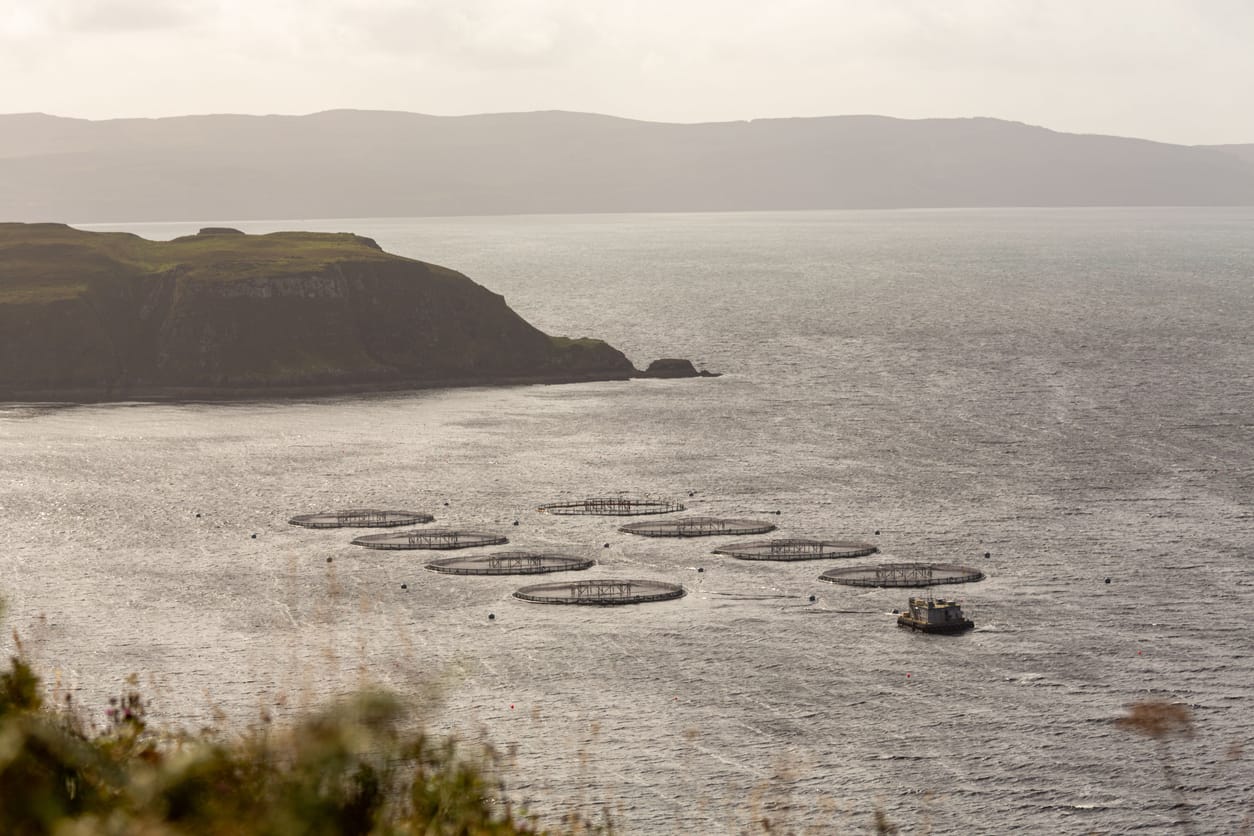
A salmon fish farm in Loch Ainort on the Isle of Skye. Image: Wirestock/iStock
“Discovery tour”
Quarry Point was restocked in mid-September, weeks before ASC published a press release about a tour to two “loch-based” ASC-certified salmon farms in Scotland, which it said were owned respectively by Bakkafrost and Mowi.
Neither farm was named in the release, but The Ferret was able to identify Bakkafrost’s Quarry Point site by cross-referencing distinctive coastline features and a pontoon photographed on the tour with satellite images and maps of ASC certificates in Scotland.
ASC confirmed Quarry point was visited as part of the tour and that it was aware of “exceedances which occurred during the sensitive period”.
“A veterinarian may exempt fish from being treated” for lice, however, “for example in situations where treatment would compromise fish health and welfare,” said ASC’s Sophia Balod. “This exemption process was in place at Quarry Point and as such continued certification was justified,” she added.
“Following a successful surveillance audit by an independent [conformity assessment body] in July 2025, Quarry Point retained its certification status and is therefore considered a suitable location to demonstrate the practical application of ASC standards and their role in driving innovation and trust.
“The Discovery Tours offer participants an invaluable opportunity not only to meet producers, but also to gain a deeper understanding of the real challenges facing our industry today,” added Balod.
“It’s a chance to see the full picture behind responsible production—celebrating what we do well while engaging openly with the issues we continue to navigate.”
The Green Britain Foundation (GBF) said The Ferret’s investigation demonstrated how “factory farming of salmon is an irretrievably broken business model”.
“It can only work if environmental and fish welfare regulations are routinely ignored," said GBF’s director, Dale Vince. “I wonder if the buyers on the tour were made aware of this. And if, in turn, they might make their customers aware that the fish on their plate came from a farm that breached parasite limits week in, week out.”
Our farmers take animal health and welfare seriously and work under some of the toughest regulations anywhere in the world.
Animal welfare charity Animal Equality said our investigation revealed that “the bodies supposedly responsible for holding Scotland’s salmon farming industry to account … have no teeth”.
“What is the point of a certification system that looks the other way in the face of blatant breaches? How can anyone have confidence in a framework that seems designed not to confront uncomfortable truths, but to bury them?” asked Animal Equality’s UK executive director, Abigail Penny.
“When farms plagued by lice can still breeze through certification – and, farcically, be paraded on guided tours – it becomes painfully clear that this scheme is failing both animals and consumers.”
The Ferret contacted all three wholesalers who attended the tour. Holland America, a cruise line, and Italmark, an Italian supermarket chain, did not respond. Walmart, which was represented on the tour by subsidiary members-only supermarket company Sam’s Club, declined to comment.
In November, analysis of lice counts submitted to the Scottish Environment Protection Agency (Sepa) showed that a quarter of salmon farms in Scotland exceeded lice thresholds for the sensitive period, according to an Animal Equality report.
Over 600 weekly counts exceeded the threshold this year. For almost 500 more, no count was carried out. Weeks after Animal Equality published its findings, Tesco cut ties with another Bakkafrost farm which breached lice thresholds then allegedly misreported the site as empty.
“Poor enforcement is endemic across this industry,” Abigail Penny added. “Both the Scottish government and accreditation bodies rely far too heavily on industry self-reporting, seemingly accepting assurances at face value instead of applying real scrutiny,” she said.
“Time and again we uncover serious welfare abuses - chronic lice infestations, neglect, and even deliberate cruelty - yet the very schemes and authorities meant to prevent this appear more interested in protecting their own reputations.”
The Scottish Government said “any suggestion that scrutiny is not being applied is simply wrong” and that salmon farming is a “robustly regulated sector”. A spokesperson added that enforcement notices were issued where necessary, and legislation was in place to make sea lice reporting mandatory.
THE FERRET: 10 YEARS AND COUNTING
You've just read our reimagined Ferret. After a decade of investigations that sparked change across Scotland, we've refreshed our look and sharpened our focus.
But our mission hasn't changed: fearless accountability journalism, powered entirely by readers like you.
New look. Same digging. Support independent journalism.
The residents of Umm al-Khair in the West Bank were already reeling from the loss of community leader and English teacher Awdah Hathaleen. Now they are fighting a mass demolition order on their homes. Human rights organisations say it’s become a symbol of the struggles of life under occupation.
There have been hundreds of applications for battery energy storage schemes (BESS) across Scotland. They are part of the Scottish Government’s drive to meet net zero targets but some communities oppose them including villagers in Kintyre.
The Lochaber food bank in Fort William claims energy multinational SSE tried to "rip them off". After a year of fighting – and questions from The Ferret – it has received an apology. But it's still being charged more than £10k.
Scotland’s largest university has turned to Nous Group at the same time as it is making savings that could lead to nearly 2,000 job losses. Staff say they were misled about the extent of its work.