The Ferret exposed the extreme views of Reform UK’s Scotland’s candidates before Nigel Farage promised to improve his party’s “poor” vetting processes, but many of them have been re-selected to fight the Holyrood election.
Anas Sarwar's party accepted over £7,000 from Stonehaven, a lobbying firm which represents the owner of Scotland's last nuclear power station. Scottish Labour has sought to make nuclear power a battleground in the May election.
It’s Christmas in Bethlehem. But children in the West Bank face violence and fear
Mohammed was 17 years old when he was shot by an Israeli sniper in Bethlehem. Two years on, his family say there is no accountability for his death. Their story is one of dozens from across the West Bank, it is claimed, with human rights organisations calling for child rights to be upheld.
At the mosque, early morning prayers had only just begun in Bethlehem when Ali Azya heard the single shot.
That 10 November night in 2023, had been relatively quiet in his building. But across the West Bank, Israeli forces had continued mass detentions that followed the 7 October attacks by Hamas, arresting 51 people in Palestinian authority controlled cities, towns and villages. They arrested 14 in Bethlehem province, as the army stormed the city, and refugee camps Dheisheh and Aida, where Ali lives.
Despite the turmoil, he had risen as usual that Friday, washed and dressed and left for prayers. His wife, Ayat – up most of the night with their baby girl – had turned over to go back to sleep. His 17-year-old son Mohammed was already up, he remembers. “But he was going to join me later.”
His eldest daughter, a medical student, was downstairs at her grandparents home. She was awake too, head in her books. And when she heard the shot ring out, it made her heart race. “She knew Mohammed would be on his way to the mosque and was immediately worried,” Ali says.
This story exists thanks to you.
The Ferret doesn't answer to advertisers, owners, or paywalls. We answer to you, our readers and over 2,000 members who support journalism that holds power to account.
She ran up to the family’s small flat but, finding it dark, continued to climb the stairs of the building to the roof, where her father had turned a small shed he used for storage into a place for his son, in his senior year, to study. “That’s where she found her brother lying on his side,” says Ali. “He was born on a Friday after morning prayers and that’s when they took him too. He was a gift.”
Mohammed had been shot by an Israeli sniper, according to documentation collected by human rights organisation Defense for Children Palestine. That weekend, he was just one of five children shot across the region within 24 hours, according to the NGO. Israeli forces also killed 12-year-old Lutfi Turkman, 14-year-old Qais Dweikat, 17-year-old Ahmad Khalaf, and 13-year-old Mohammad Zayed, during a military raid of Jenin, in the north. The Israeli Government has said its raids aim to target those responsible for terrorism attacks on its citizens.
The Ferret is here to tell Mohammed’s story because, according to human rights organisations like Save the Children, Israel is violating the Convention on the Rights of the Child. The country denies this. But NGOs are calling for international action.
__
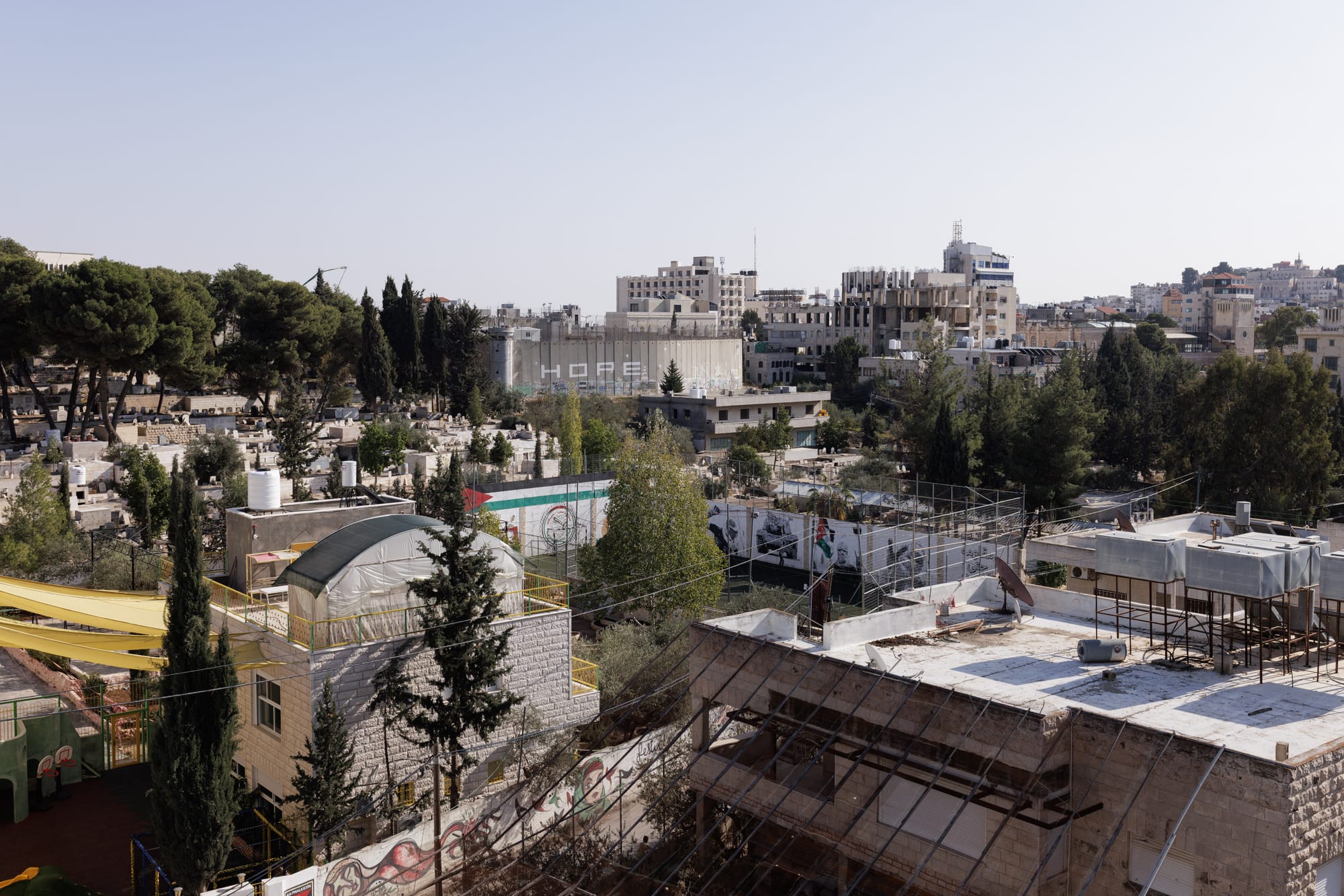
The view from an Aida Camp rooftop. Credit: Valerio Muscella
Bethlehem is known for its rich cultural and religious history. It’s considered the birthplace of Jesus, celebrated by Christians who believe he was the son of God, and recognised by Muslims like the Azya family, who see him as an Islamic prophet.
The Ferret is here as the historic city prepares to publicly mark Christmas for the first time in two years – during the bombardment of Gaza, city-wide celebration was cancelled. But this December there are lights on the huge, traditional Christmas tree outside the Church of the Nativity.
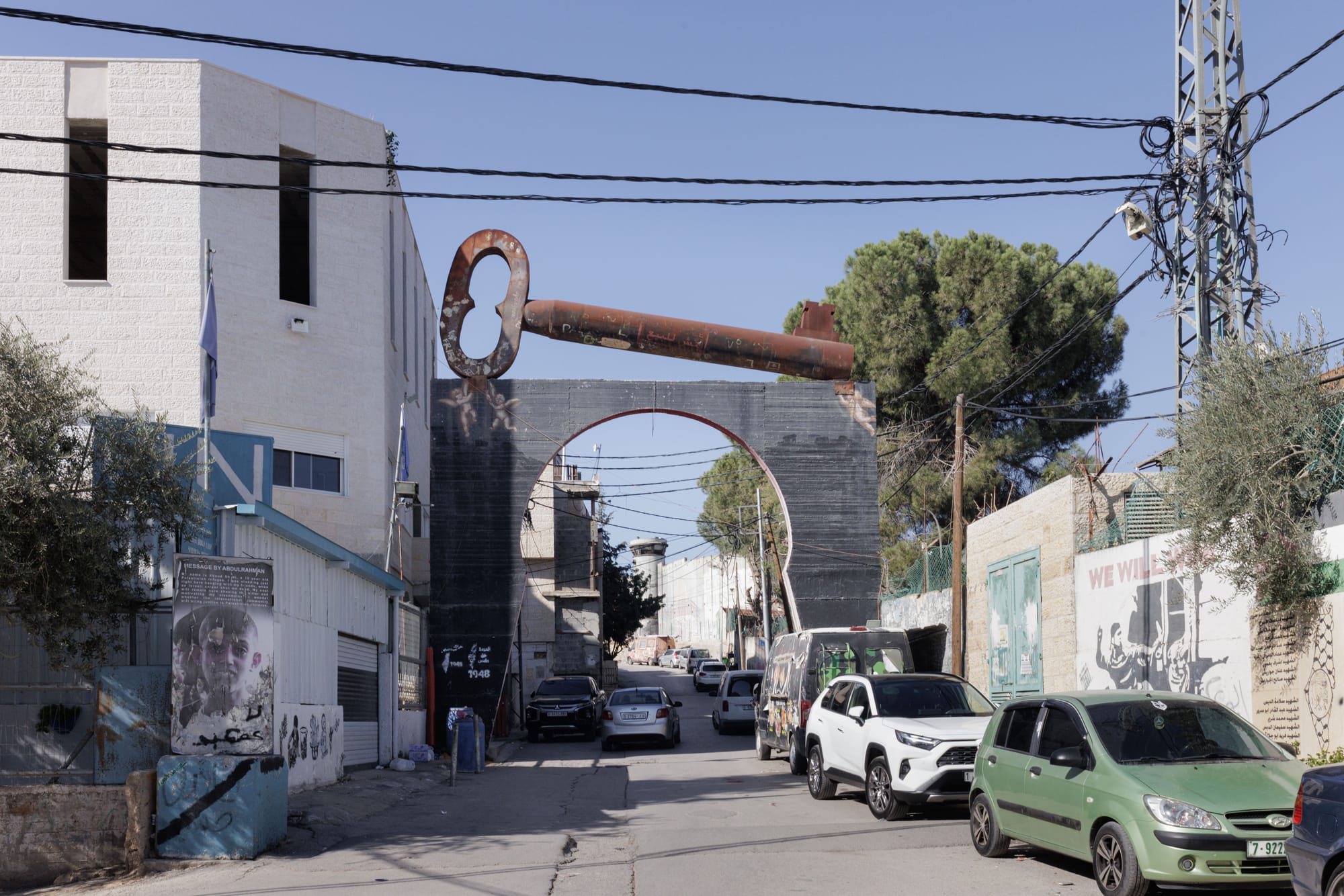
Aida Refugee Camp, which is less than three kilometres from the church, was founded in 1950 and is home to an estimated 5,000 people, who originally fled here from 28 villages, in what is now known as Israel. Its main entrance is marked by an archway, over which a huge sculpture of a key sits, a constant reminder of the right of return to their homelands, which Palestinians argue should be granted to them under UN Resolution 194. In reality, freedom of movement for most people here is heavily restricted. A 2017 study by Berkeley Human Rights Centre found it, along with Dheisheh camp, was likely the most teargassed place in the world.
The sculpture of a key at the entrance to the camp evokes the Palestinian call for a right to return to their homelands. Credit: Valerio Muscella
Standing on the roof of the Lajee Centre, a youth organisation near the camp’s entrance, the illegal West Bank Barrier – or apartheid wall – looms into clear view along with the Israeli settlements of Homa and Gilo, also illegal under international law. In front is one of seven military towers, often manned by soldiers with rifles and placed at regular intervals, along with clusters of security cameras.
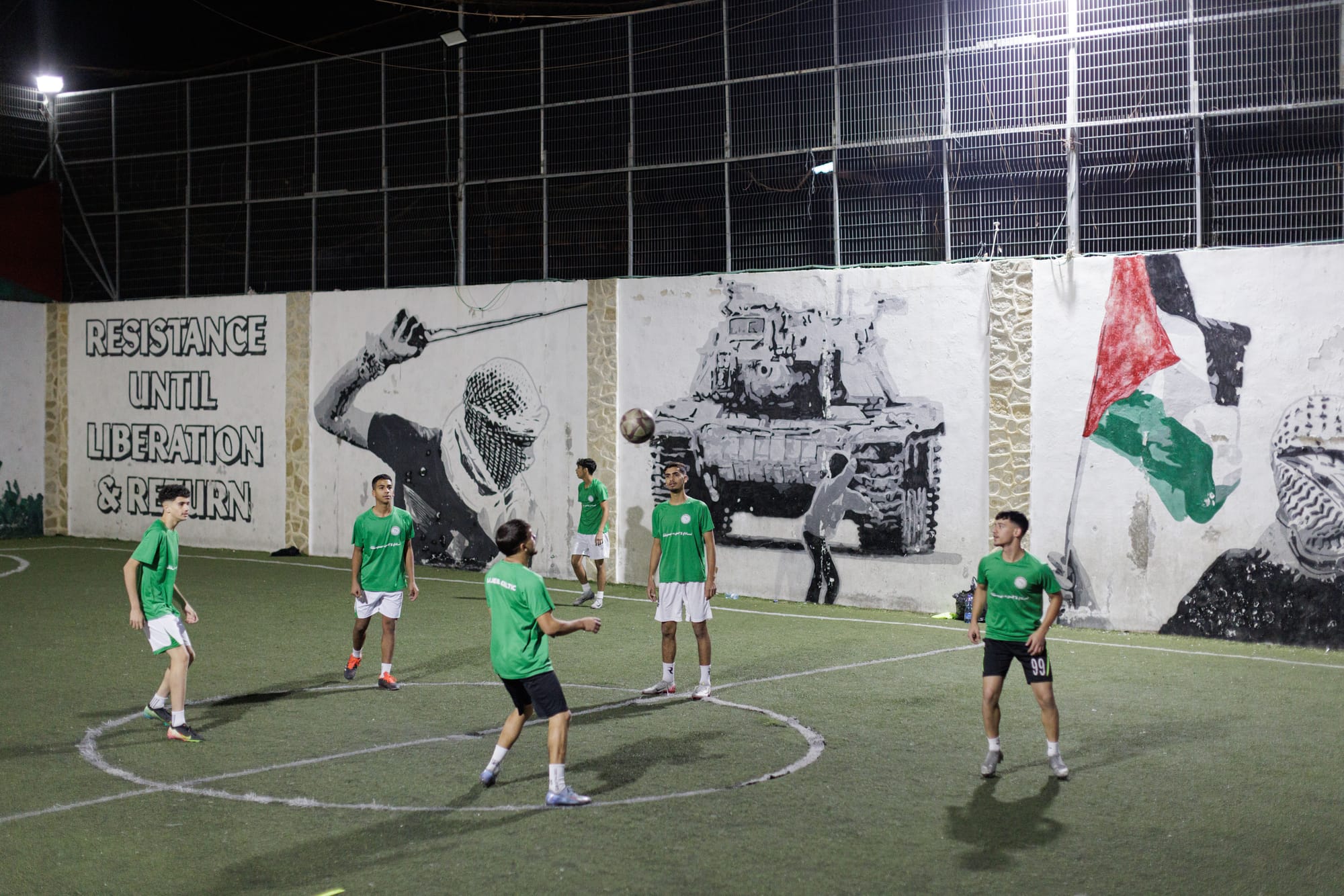
Below us is Lajee’s football pitch – its team, Lajee Celtic was founded with the help of money raised by Celtic FC ultras fan group, the Green Brigade. Beyond that, is the cemetery where Mohammed is now buried.
On that fateful night, the Azyas explain as we sit in their small flat surrounded by pictures of their son, Mohammed’s sister ran for help. Her father, alerted by others as they emerged from prayers, ran to him as soon as he could. “He was still alive,” says Ali. They didn’t know that an ambulance, called by the neighbours, had arrived but had been stopped and blocked from entering the camp by the Israeli army. “He needed urgent medical attention,” says Ali. He picked up his son and ran for his car to drive him to hospital.
But as the car rounded the corner by the Lajee Centre near the camp’s entrance, he says soldiers – the laser beams of their guns trained on their vehicle as they shouted – forced them to a stop.
“Mohammed was at the point of taking his last breaths,” says Ali. “But the soldiers told me: “Get him out of the car.” He claims his son was placed on a stretcher and carried to the military outpost where Ali was told he would be treated. Soldiers searched the car and then marched him back to his flat to look for weapons.
“The soldiers kept shouting: “Where are the weapons?” But they found nothing,” says his mother. “We were in such shock we couldn’t speak. Eventually they saw that. One of them told me Mohammed had been taken to hospital. He said: ‘Look, I have kids too.’ And they left.” She shakes her head in disbelief.
His family question whether Mohammed ever made it to hospital, a concern also recorded by Defence for Children Palestine field researchers. The next day the family received a call from officials and, accompanied by the army, went to a military point where they retrieved his body from the back of a pick-up truck – in a blue, plastic sack. The Ferret has seen video verifying this.
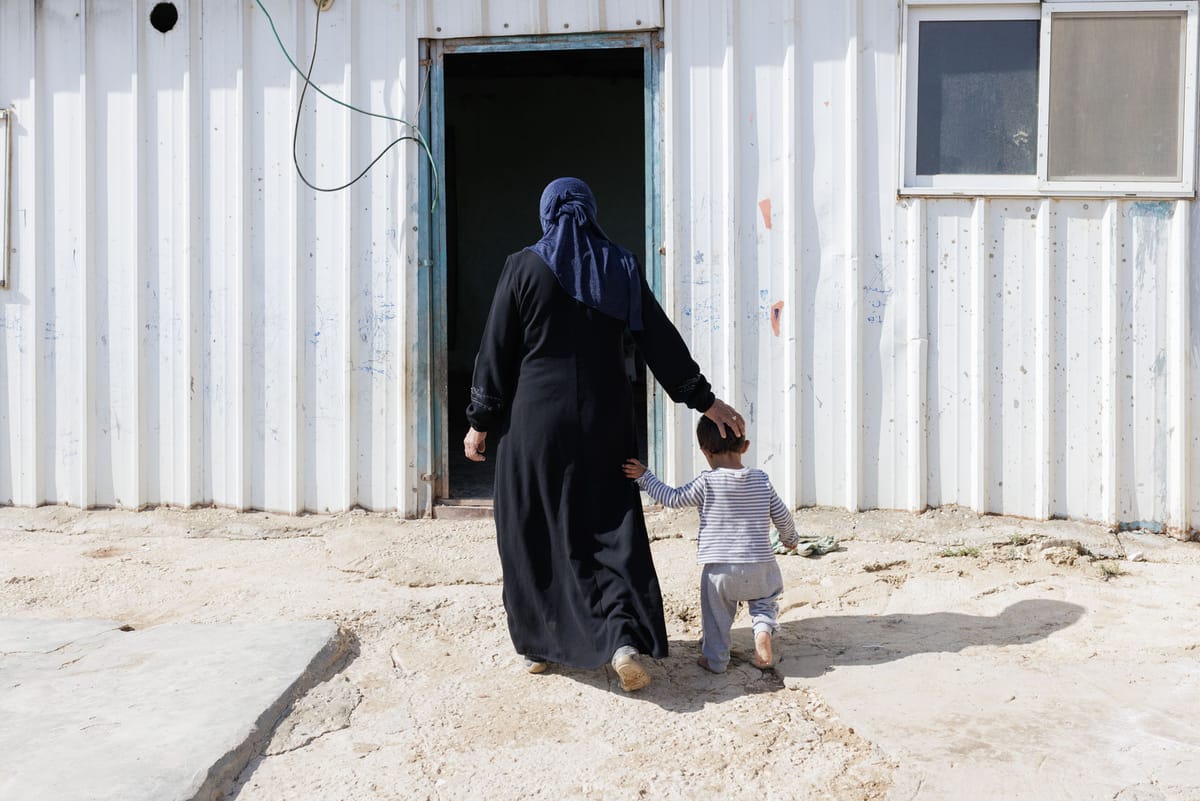
“We miss Mohammed every day,” says Ali. His hand rests on the head of his two-year-old daughter. “There is a sadness inside that will never leave,” adds his mother. She takes comfort from visits of his classmates and neighbours who tell stories of his outgoing, spirited nature. “Then it feels like he is not forgotten,” she says.
No Israeli soldier or official was held accountable for his killing, as is the case with virtually every Palestinian child killed by Israeli forces.
This family is not unique. Search through news reports over the last two years and there are dozens of images of smiling teens, shot by soldiers. Since October 2023 at least 224 children have been killed in the West Bank. The most recent is 16-year-old Ammar Yaser Sabbah, shot in the nearby town of Tuqu on 14 Dec. Israeli forces said he was involved in a riot. The Palestinian Authority said soldiers had been firing indiscriminately.
There are child victims of this conflict from Israel too. In figures from the Israeli Government, 38 are listed amongst those killed during the Hamas attack on Israel on October 7, 2023. Meanwhile in Gaza the United Nations estimates the loss was the equivalent of 28 children every day of the bombardment, the size of an average primary school class, and more than 18,000 in total. Dozens more children have been killed there since the ceasefire was brokered on 11 October.
But human rights organisations are better able to investigate here in the West Bank than in Gaza. In its 2024 report, Targeting Childhood, Defence for Children Palestine found Israeli snipers “routinely shoot to kill Palestinian children as they are going about their daily life”. It claims Israeli forces “deliberately prevented an ambulance or paramedics from providing aid to a bleeding child” in 43 per cent of the 141 cases it looked at.
“Mohammed's case, unfortunately, is par for the course,” adds Miranda Cleland, the charity’s advocacy officer. “No Israeli soldier or official was held accountable for his killing, as is the case with virtually every Palestinian child killed by Israeli forces.” She claims this is due to “a lack of political will”. “If Israel wanted, it could easily determine who fired the shot,” she says. “Palestinian communities are among the most surveilled in the world and there are cameras everywhere.”
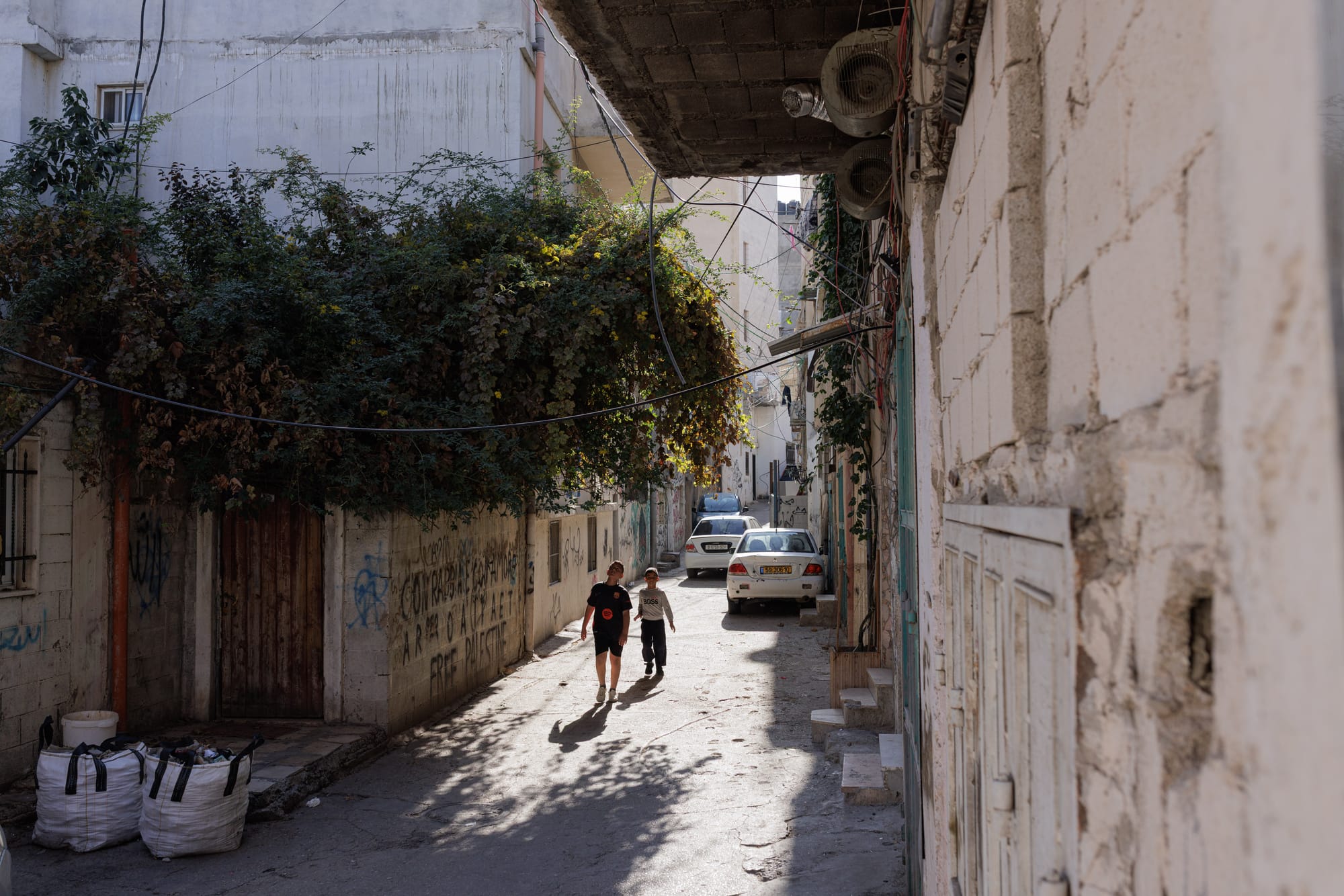
Childen in the streets of Aida Refugee Camp. Credit: Valerio Muscella
For families, grieving the loss of their child combined with this lack of liability “equals a lack of closure,” according to Cleland. In many cases, she adds, the child’s body is confiscated, denying families the ability to bury or mourn. “Parents know that they cannot protect their children from Israeli forces and that lack of safety permeates every part of life for Palestinian children and families,” she adds.
Ghadeer, a mother of three whose second name we are not using to protect her children and who lives just a few minutes from the Azyas, relates to this. Her husband is currently one of over 3,000 Palestinians in unlimited administrative detention, the practice of holding people who have not committed an offence, based on the claim that they pose “future security threats”. Its use has escalated dramatically since 7 October. Of some 350 Palestinian minors currently imprisoned by Israel, almost half have not been charged.
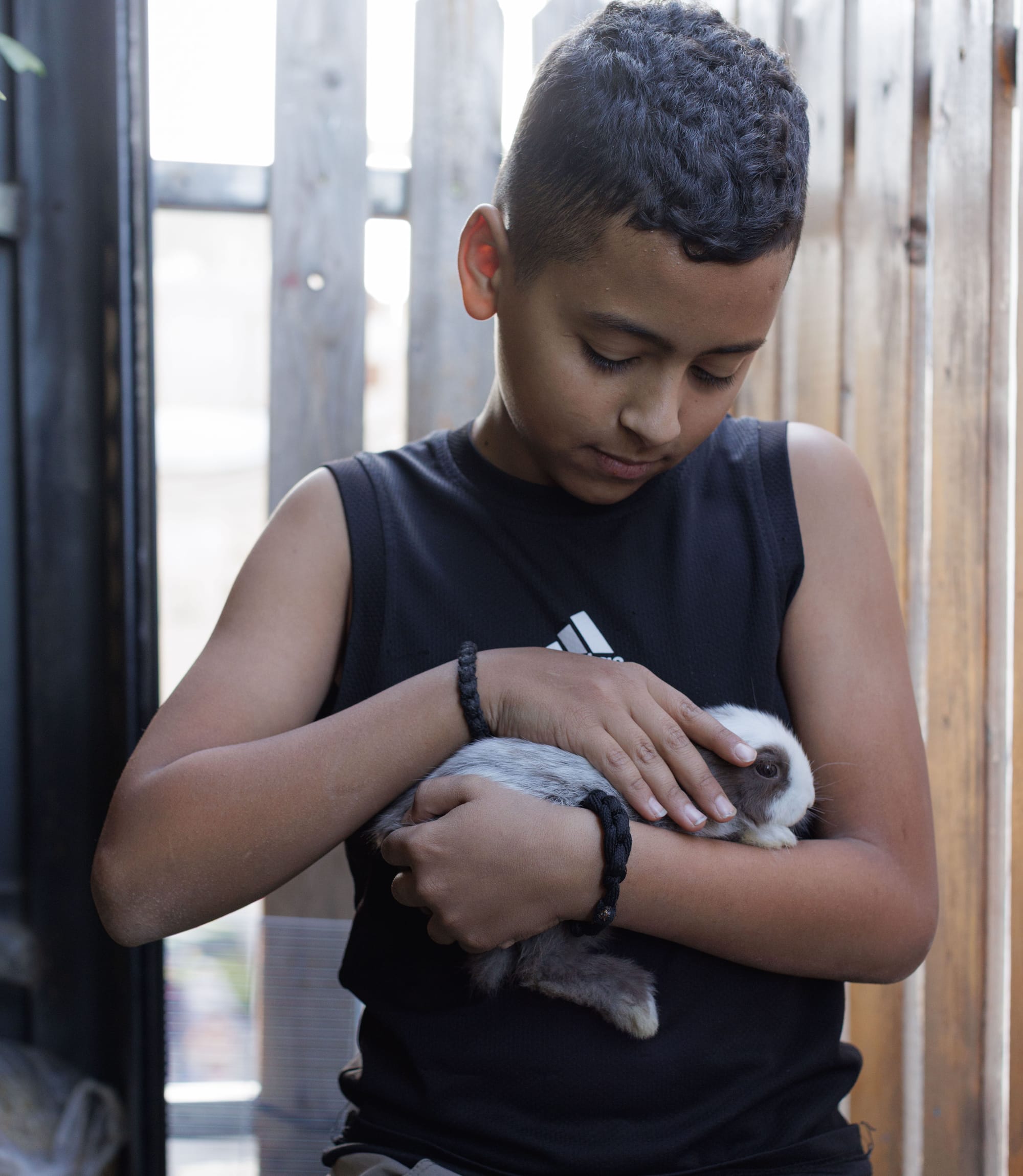
“Now it is my responsibility alone,” Ghadeer says of making sure her children stay safe. Her two oldest, 11-year-old Mostafa and 15-year-old sister Diala, point out the military tower right outside their living room window, which was set alight ten years ago in protest at conditions here. After Mohammed was killed, some set fire to it once again. On the balcony, Mostafa shows me his pet rabbit, Oreo, and points out the bullet holes in the wall from stray gun fire.
“People like us go to sleep scared that something will happen during the night,” Mostafa explains. “Whenever I realise that the soldiers are in the camp my body starts shaking.” He shrugs. “The kids in Scotland would never understand what our feelings are and it’s so hard to explain to them.”
Mostafa and his rabbit Oreo. Credit Valerio Muscaella
A year ago, he says, he woke up to soldiers breaking down the main door of his block of flats to arrest his father, and shouting in a stairwell. When one came into his room, pointing a gun, he immediately put his hands up, he says.
After they arrested his dad he didn’t go to school for three days: “Because I couldn’t stop crying.” They used to play Playstation together. Now it lies untouched. The children show me a video taken that night of their dad, standing with his hands tied, blindfolded on their street. They kept him there, in sight of his family, for hours, they claim.
The Lajee Centre is also frequently raided, says Diala. When the army stationed snipers on its rooftop last month it meant she took the long way around to school. Staff there confirm this.
Alison Griffin, head of conflict at Save the Children UK, called for an end to occupation: "Palestinian children are being robbed of their right to a safe childhood, facing ongoing threats of military detention, home demolitions, and harassment and intimidation by Israeli forces or settlers,” she explains.
"The international community has a legal and moral duty to uphold international law and address the root causes of repeated violence and a decades-long child rights crisis for children across the occupied Palestinian territories."
__
In July last year Diala’s 15-year-old friend, Wajeeh Abu Aker, was picked up and taken to prison. When she walks down the street, where they used to play together from the age of eight, she thinks of him.
Lajee Celtic's senior team train in the shadow of the wall. Credit: Valerio Muscella
A keen footballer, he was part of Lajee Celtic’s under-18 team. That evening, we watch the senior squad go through their drills on the small pitch in the shadow of the wall. Volunteer coordinator Samir al-Amir, who finished a 19 year prison sentence two and a half years ago, explains the impact he sees on teenagers.
“Some guys here [in the camp] might get arrested,” he says. “Some might be killed. We have to tell them the truth. We explain to our children and support them. It's our struggle as Palestinians. We are under occupation."
Lajee Celtic offers a place where young people can come together from right across Palestine – a chance often denied them – even tonight there are players from the camp, from Bethlehem city and beyond. It lets them explore what they want from life and strengthens their own sense of identity and resilience, he says.
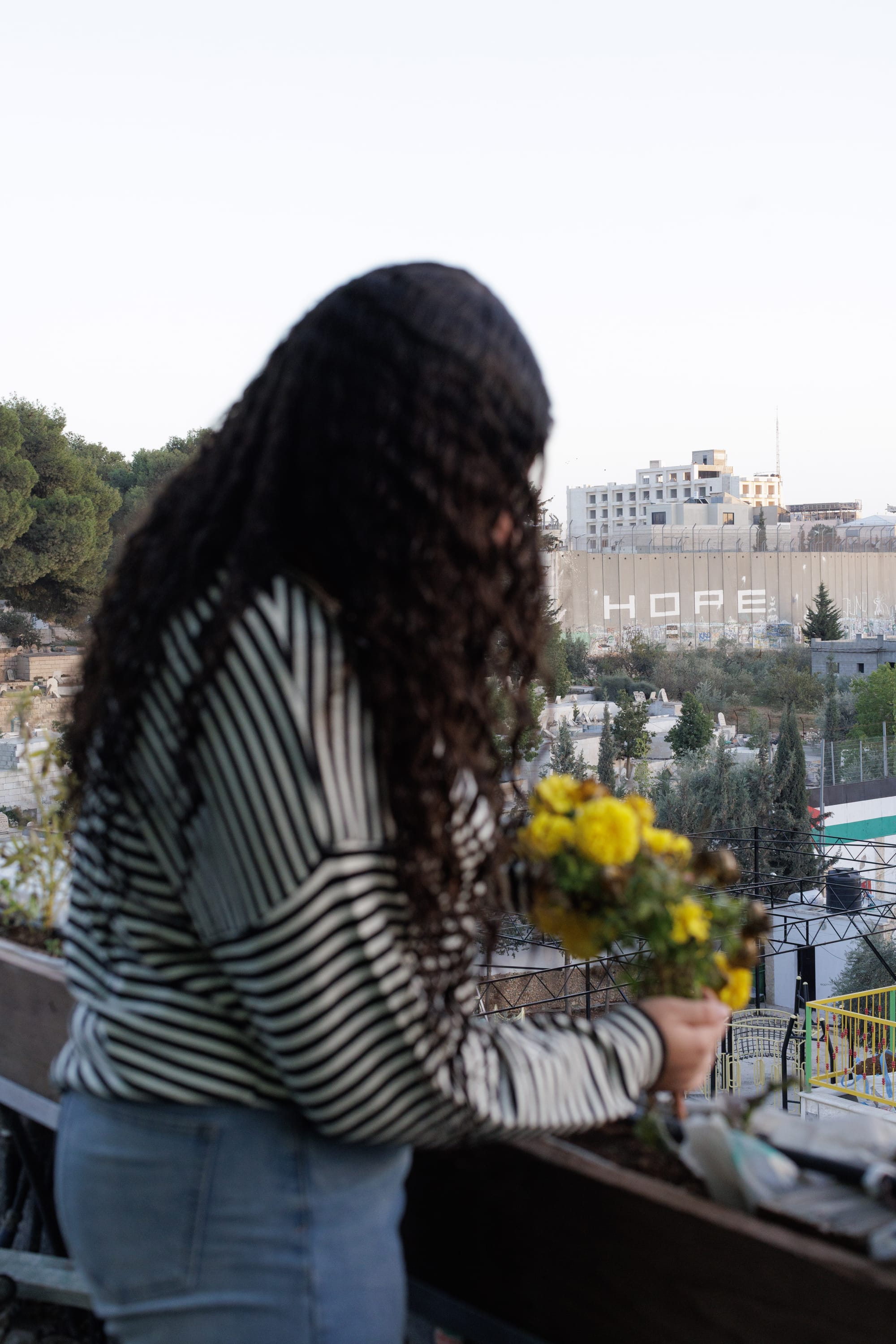
The Lajee Centre, he explains, is about “helping the children’s dreams become reality”. Mostafa, who is part of the centre’s “Rebel Circus” wants to be famous. Diala hopes to be a nurse or a midwife. But meanwhile she goes to school and tends the roof top garden at Lajee, watering green shoots and harvesting cucumbers, tomatoes, courgettes and aubergines. When she looks down from there she sees the pitch where Wajeeh played, and the cemetery where Mohammed was buried.
She cannot see the prison where her father is, hundreds of miles away in Israel. But on the barrier wall she can pick out one word – hope, it says in letters large enough to read from afar.
Diala on the roof of the Lajee Centre. Credit: Valerio Muscella
The Israeli embassy did not respond to The Ferret’s request for comment.
Additional reporting thanks to Meras Al Azza Cover image by Valerio Muscella
The Ferret is Scotland's member-owned investigative journalism outlet. For ten years, we've been digging deeper into the stories that matter, holding power to account without fear or favour.
We don't have billionaire backers or corporate interests. We have you.
Every investigation you read is funded by readers who believe Scotland deserves better journalism. Join them.
Karin is The Ferret’s co-editor and has reported on people, power and planet for the UK’s leading outlets. She co-founded our Community Newsroom in Glasgow and is interested in participatory approaches to journalism. Audio is her favourite medium.
Anas Sarwar's party accepted over £7,000 from Stonehaven, a lobbying firm which represents the owner of Scotland's last nuclear power station. Scottish Labour has sought to make nuclear power a battleground in the May election.
A Ferret investigation has found there was no registration to sell vapes at the Union Street premises in Glasgow where a major fire started - and we can reveal the name of the company behind the shop.
Huge volumes of sewage sludge have been used to fertilise Scottish farmland. Studies show it contains microplastics, forever chemicals and cancer-linked pollutants.