Climate change is causing rising sea levels and coastal erosion and 109 Scottish golf courses are at risk. We examined the issue as part of Green drive: Golf and the environmental crisis – a special Ferret series on golf and the environment.
The Ferret exposed the extreme views of Reform UK’s Scotland’s candidates before Nigel Farage promised to improve his party’s “poor” vetting processes, but many of them have been re-selected to fight the Holyrood election.
Anas Sarwar's party accepted over £7,000 from Stonehaven, a lobbying firm which represents the owner of Scotland's last nuclear power station. Scottish Labour has sought to make nuclear power a battleground in the May election.
Books are being removed or restricted in Scottish school libraries following complaints, creating a “chilling effect” that campaigners warn threatens both freedom of speech and inclusive education, an investigation by The Ferret has found.
Freedom of information requests to Scottish councils by The Ferret revealed dozens of complaints about "inappropriate" books, more than a third in connection with LBGTQ+ themes. There were also complaints about LGBTQ+ events such as drag queen story hour, which have drawn protests and abuse in Scotland.
As a result, some librarians told The Ferret they are “thinking twice” about putting potentially controversial books on display, concerned that they could face organised online campaigns and doxxing.
They said it was time for proper guidance to ensure that all children and young people had access to the widest possible range of appropriate reading material.
The FoIs detailed a total of 29 official complaints about books in school libraries from September 2022 to September 2025. At least six books were removed. However, experts believe that far more complaints were made through informal channels, and warned the issue would likely get more prevalent in years to come.
Some raised concerns that the climate had echoes of the ‘moral panic’ before the introduction of Section 28, a controversial law from 1988 that banned local authorities from "promoting homosexuality" in schools and through published materials, repealed in Scotland in 2000.
In recent years banning books in public and school libraries has become a significant issue in the US. Freedom of expression group Pen America found thousands of books were banned from public schools between 2023 and 2024.
But the issue has also reared its head in Scotland. Many of the challenged books in Scotland were banned in the US.
They included the American picture book Julian is a Mermaid by Jessica Love, which has been frequently challenged and banned by school libraries in the US since publication in 2018 due to its trans themes. Others include Trans Mission: My Quest to a Beard by Alex Bertie, a book about a trans teen which was banned in Wyoming, US, in 2021.
Several books by trans writer Juno Dawson also featured. Her most famous – This Book is Gay, a guide for LGBTQ+ young people – is one of the most commonly banned in the US.
Reporting you can check, not just share.
We publish rigorous, sourced journalism and we correct it when it’s wrong. If you value facts over noise, help keep this work independent.
When Aidan Became a Brother by Kyle Lukoff and Kaylani Juanita, another book also banned in the US which features a transitioning young boy, was removed from a school library in Fife after complaints about the book’s concept.
Some removals were unrelated to ideological issues. Millions by Frank Cottrell Boyce was removed by Stirling council due to swearing and a book about WW2 history was also removed by Argyll and Bute because a parent alleged it was not age appropriate. Edinburgh City Council shared eight complaints about books, including several by Juno Dawson, that were upheld but didn't give details of what happened next. The local authority later said two books were removed in 2023.
In some cases access was restricted. Argyll and Bute received a complaint about All Kinds of Families by Sophy Henn, which one parent asked the school to withdraw from use as they felt “it was not representative of their view of what a family constituted”. It was retained but taken out of the “take home box”. Other books were only allowed to be taken out with parental permission.
Self-censorship
Dr David McMenemy, former librarian and academic at the University of Glasgow researching freedom of expression in libraries, says challenges to controversial topics are not new. But he added: “I think the volume of cultural war stories in the press has increased.
“I think it would be wrong to not expect that to manifest itself in terms of libraries, school libraries and public libraries because they are one of the main areas where ideas are circulated within wider society.”
For Dr McMenemy, a concern is that this will lead to “self-censorship”, with librarians potentially not including controversial books in their collections for fear of “push back”. He said “the worry of appearing in the press, or the worry of getting lots of complaints about a particular book, after an organised complaint” could lead librarians to be more risk-averse around books and events that might cause controversy.
Sean McNamara, director of the professional body for librarians, CILIP Scotland, claimed unfounded complaints could have “concerning consequences” and said librarians feared the number of “book bans” could increase.
“It is of course vital that books on school library shelves are age appropriate and therefore when a complaint is made, a skilled and trained school librarian should be empowered to make a decision on stock,” he added, warning that pressure should not come from elsewhere.
“It is vital that this is countered with strong policy and greater funding and support for school librarians in Scotland, including legal protection for the profession, as there is currently none in place.”
He said libraries were alert to controversies in the US, where books have been banned. About 80 per cent of the book bans took place in Florida and Iowa, where states enforced new laws targeting classroom learning materials about sexual content, sexual orientation, and gender. Pen America's research found 25 per cent of these banned titles included LGBTQ+ people or characters.
High profile controversies over book censorship in UK libraries include a decision to withdraw gender critical book The Women Who Wouldn't Wheesht from the National Library of Scotland’s centenary display due to concerns about its “discriminatory content”. The decision was later reversed after claims of censorship.
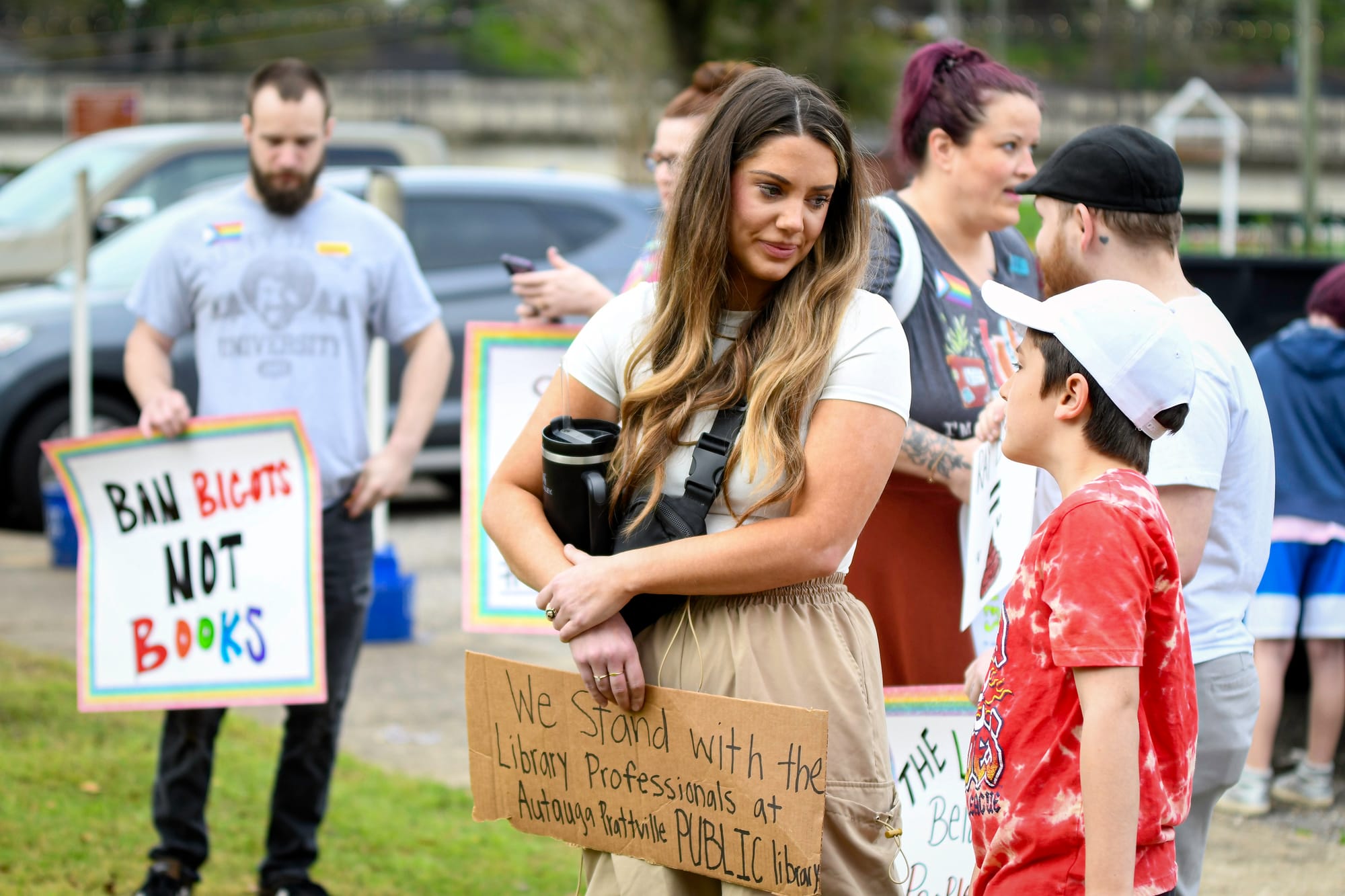
Decisions to remove books from school libraries have attracted counter protests. Image Istock/
In Kent, a Reform council leader claimed the authority had removed transgender-related books from the children's sections of its libraries. However, the council later confirmed it was relocated from a display at the entrance to a section unlikely to be visited by children.
Organisations and experts told The Ferret that though the situation in Scottish schools was far less extreme, young people and their families were being impacted by confusion over what was deemed appropriate. They stressed that books could be a “safe place” to explore the worlds around them, and urged schools not to respond to pressure without due cause.
Index on Censorship, which campaigns for freedom of expression, found more than half of 53 librarians it surveyed had experience of a book being challenged. Half of those on the receiving end of complaints had been asked to take the book off the shelves, many of which were LGBTQ+ titles.
“Very often this is happening behind closed doors, sometimes on the request of just one parent,” said Index’s Katie Dancey-Downs. “Other times schools are acting preemptively because they fear something may cause offence.”
Librarians told her about books being “hidden” in secret sections or shelves or not included in promotional displays. She said: “When these books are targeted we are actually targeting the identity, either of the young person or their families or friends, so the message that is fed back is that those identities should be hidden, rather than celebrated in an age appropriate context.”
Erin Lux, policy coordinator at the Equality Network said this was a “growing trend” and stressed that “there is nothing age inappropriate about being LGBTQ+”. She added: "LGBTQ+ books being removed from libraries, moved to senior sections, or otherwise made more difficult to access is deeply concerning”.
Some campaigners claimed the impact of the “chilling effect” meant that libraries and teachers were more reluctant to take risks. One librarian told The Ferret that while they had not been challenged or had to remove books they admitted they do at times “second guess myself as a librarian”.
There is nothing age inappropriate about being LGBTQ+. — Erin Lux, Equality Network
Another said complaints could “potentially lead to self-censorship”. “School librarians feel both explicit and implicit pressure to avoid conflict, while trying to do their jobs,” they added. “While hopefully librarians will not remove books, they may feel pressure to remove some from open collections and limit access”.
Several raised concerns that funding cuts that reduced librarians in councils like Glasgow and North Ayrshire mean that schools may be more likely to make conservative choices and remove a book if a complaint is made because of the lack of expertise on both books and policy.
Some campaigners claimed in practice the “chill factor” could be similar to Section 28, a policy brought in by Margaret Thatcher’s Conservative government in 1988 which aimed to “prohibit the promotion of homosexuality”. The law was introduced following outcry over an educational book called Jenny Lives with Eric and Martin.
Hels Bowie of LGBT Youth Scotland said some books were becoming part of the “culture war”.
“What we hear is that the concerns raised about trans and non-binary young people today – and the regression in rhetoric and rights that they have – seems marked and familiar to those who remember Section 28," they added. "We hear fears raised by our partners about the potential for something similar to come about again”.
They said that homophobia and transphobia, experienced by many LGBTQ+ young people on top of struggles with mental health and anxiety, could leave them feeling isolated, and removing books where their identities were represented compounded problems.
In response to The Ferret’s findings, the teachers’ union, EIS, said that since 2021, all local authority run schools were expected to deliver LGBTQ+ inclusive education.
A spokesperson for Argyll and Bute council said only one book had been removed from its libraries, and said it was committed to “inclusive, rights‑based education”. They added: “Access to a diverse range of books is an important part of children’s learning and development”, they said, and pointed to various initiatives supported by Argyll and Bute council including Time for Inclusive Education (TIE) and the LGBT Youth Charter.
A spokesperson for Edinburgh City Council said two books had been removed in 2023, but that complaints being upheld “did not mean that the books were removed from stock”. “In most cases, books were either reshelved within the library to an age-appropriate section or information was added to the book cover to recommend an age range reflecting publisher guidance.”
Fife Council’s head of education Shelagh McLean claimed schools work to make sure children and young people develop positive attitudes on inclusivity. "Reading and a love of books help underpin these values and all schools encourage access to a wide range of age appropriate reading material," she said.
'Months and months' of abuse: The backlash to events in libraries
Events in libraries have become a major culture war flashpoint across the UK in recent years, with staff and performers receiving significant abuse online and facing protests outside local events.
The Ferret’s research revealed local authorities have registered complaints about 15 events including drag queen story hours and other LGBTQ+ themed public events hosted or supported by schools or public libraries.
The majority of these focused on a single event in Moray, where a drag queen called Ms Lossie Mouth hosted a drag queen reading for children and parents in Elgin library.
First started in the US, drag queen story hours, which usually consist of a drag performer reading children’s books to groups of parents and children, have been a target of organised campaigning from those who see it as inappropriate. As well as the event in Moray another in Dundee has faced backlash in recent years.
There have also been protests and attempts to stop ‘gender critical’ events in libraries. In the Edinburgh suburb, Portobello, in 2023, there were demonstrations at a meeting over concerns about how gender identity was being taught in schools.
One now-retired librarian, Cleo Jones, helped to organise an online drag queen story event in Edinburgh during the Covid-19 pandemic, but was not prepared for the backlash which lasted “literally months and months and months”.
During the event, she claims she noticed people attempting to login into the online space who appeared to be based in the US, leading her to suspect that it had been shared with opposing groups across the world. Complaints and requests for information about that and similar events continued to impact the library staff way after the event.
“It’s a tactic that [these groups use]”, Cleo said. “It's like it's filibustering, isn't it? It's like doing everything that you can and keeping hanging on by your nails”.
While she was glad she had put on the event, she would warn librarians that putting on a controversial event would be “an awful lot of trouble” and hope they would be supported by senior staff in the background.
“I think libraries need to be better at selling up what we actually do, and why we do it. It's a community space, a safe community space for everybody within that community. And we will celebrate all aspects, but that means some people are not going to be pleased some of the time.”
Help us keep digging.
If this reporting mattered to you, you can help fund the next one. The Ferret is independent, member-owned investigative journalism, backed by readers who want accountability in Scotland.
Alastair leads our fact-checking arm, The Ferret Fact Service, and writes about disinformation and conspiracy theories. He also delivers training on media literacy and spotting disinformation. He spends his free time at gigs in basements.
Karin is The Ferret’s co-editor and has reported on people, power and planet for the UK’s leading outlets. She co-founded our Community Newsroom in Glasgow and is interested in participatory approaches to journalism. Audio is her favourite medium.
Climate change is causing rising sea levels and coastal erosion and 109 Scottish golf courses are at risk. We examined the issue as part of Green drive: Golf and the environmental crisis – a special Ferret series on golf and the environment.
Anas Sarwar's party accepted over £7,000 from Stonehaven, a lobbying firm which represents the owner of Scotland's last nuclear power station. Scottish Labour has sought to make nuclear power a battleground in the May election.
A Ferret investigation has found there was no registration to sell vapes at the Union Street premises in Glasgow where a major fire started - and we can reveal the name of the company behind the shop.