



Luxury hotels and dinner dates: Who is lobbying our politicians?
High end dinners are a fraction of over 29,000 lobbying meetings in the last parliamentary term. But campaigners argue that because the lobbying spend is not declared, their significance is underplayed.

It was in the rarified environs of the Gleneagles Townhouse, a five-star luxury hotel and exclusive members club in Edinburgh’s New Town, that one of the most recent meetings logged on the Scottish lobbying register took place. The lobbyist was Jennifer Craw, chief executive of Opportunity North East (ONE), the private sector led economic development vehicle founded by Sir Ian Wood over a decade ago, with the aim of diversifying Aberdeen’s economy.
The oil and gas magnate is Scotland's third richest person and continues to donate Wood Foundation money to the organisation, though he resigned as a director in 2022. Also at the Edinburgh dinner– selecting from a menu that includes lobster and crayfish scones, seared pigeon breast, Loch Melfort Trout and Tweed Valley Sirloin – were first minister John Swinney, his deputy chief of staff Emily Mackintosh and Màiri McAllan MSP, cabinet secretary for housing, who was once an SNP special advisor.
Welcome to the world of corporate lobbying, where dozens of expensive dinners like this were held over the last parliamentary term, featuring companies from Shell to GlaxoSmithKline and Easyjet, aimed at influencing political policy over fancy food and drinks.
Fund journalism that serves the public.
The Ferret investigates what’s going on in Scotland, and who benefits. Reader support keeps our journalism independent.
Who influences our politicians?
Right now, our politicians are looking to persuade voters to back them in the Scottish Parliamentary elections on 7 May. Meanwhile, in an exclusive analysis of Scotland’s lobbying register, The Ferret can reveal who is influencing our ministers and MSPs, and how political decisions could be impacted by powerful interests.
Since 2018, all regulated lobbying – in-person or video call meetings with politicians that organisations and charities have instigated, rather than been invited to – must be logged.
Using data from the last parliamentary terms we found organisations lobbying on behalf of the private sector – either companies or business associations representing them – make up over 40 per cent of the meetings logged on the register, with PR firms and specialist consultants’ meetings accounting for a further eight per cent. Those encounters often involve lobbying on behalf of private clients.
“Generally, commercial lobbying is about a return on investment,” says Juliet Swann, from campaign group Transparency International UK, pointing out that corporations would not continue to spend money if it didn’t work. And often, she says, the success of lobbying is about “the strength of relationships as much as the messaging itself.”
Back at the Gleneagle’s Edinburgh outpost that evening, those dining needed no introductions. It was hosted on behalf of ONE by True North Advisors, the PR firm representing it. True North is run by former SNP staffers Geoff Aberdein and Fergus Mutch who both started their careers working for Alex Salmond and later served – a few years apart – as his chief of staff.
While they were in politics Swinney was in post as finance secretary and then as deputy first minister. Emily Mackintosh, meanwhile, was an SNP communications officer working under Mutch when he was the party’s head of research and communications.
The relationship between True North and its client is also longstanding. Aberdein first met Wood when he was working as a waiter at an Aberdeenshire country club and later was a director of ONE for several years, resigning in December 2020. The organisation was one of True North’s first clients, having been set up in November of that same year.

This dinner could be seen as thank-you, after the Scottish Government agreed to match fund a donation of £40m from the Wood Foundation in October 2025, with £20m of public money going to both ONE and the Energy Transition Zone (ETZ) limited. Both not-for-profits were set-up by Wood, who is still a director of ETZ.
Lobbying notes reveal only that the meeting aimed to “reinforce the positive impact of ONE” and explain the importance of the money in its plans for “economic diversification...through innovation, entrepreneurship and investment”.
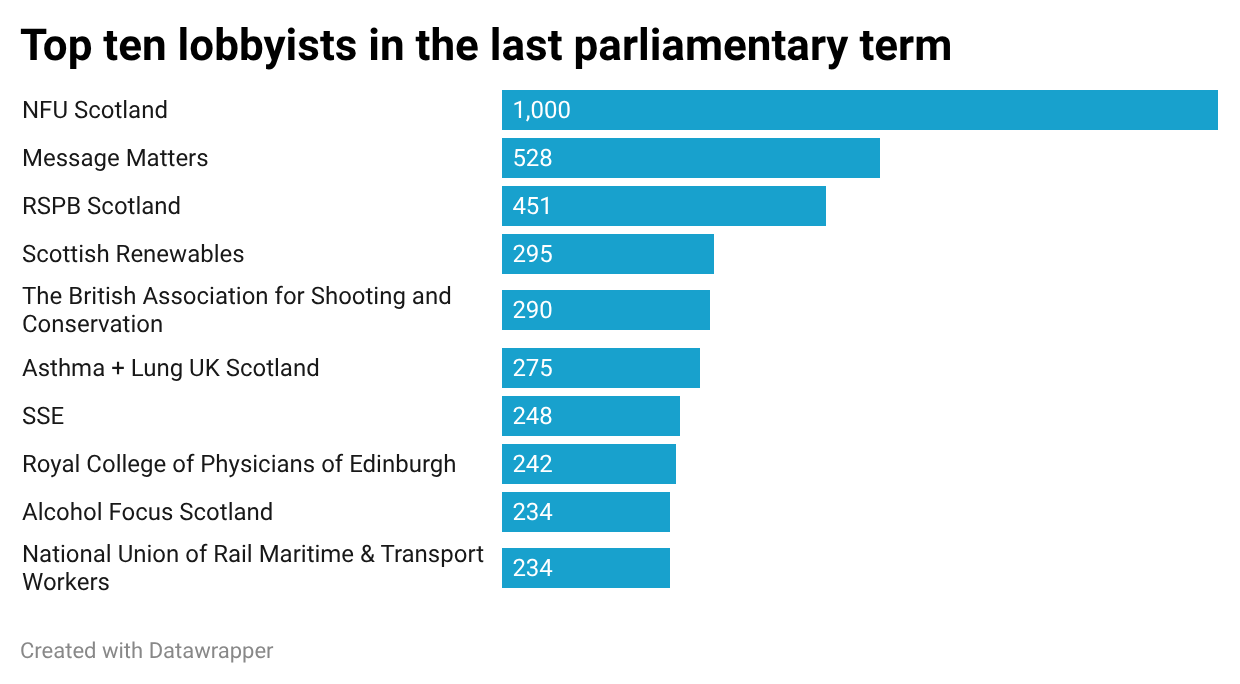
This type of dinner, a spokesperson for True North told The Ferret, was “the exception rather than the rule” for its lobbying activity, making up just 10 per cent of its reported activity. And it was just one in a sea of 29,000 influencing meetings in total, recorded on Scotland’s lobbying register in the last Scottish Parliamentary term.
Loopholes and unequal access
But for almost eight years, loopholes in the register – which have been flagged repeatedly by campaigners – have gone unaddressed.
“The current lobbying register gives us a very partial view of how the influence game goes,” says Will Dinan, a senior lecturer at Stirling university, who specialises in political communications.
“There’s no need to log a phone call, for example, or an email and lobbyists can also use the constituency exemption, which means if a lobbyist comes to a politician as part of constituency business it doesn’t need to be logged." That means follow-up after dinner is unrecorded if it's not face-to-face. Dinan adds: "We can be cynical and say this is just the way the world works, but how can we hold everyone properly to account if we don’t have all the information?”
Our analysis also highlights the fact that not all access is equal. The lobbying entries logged as “conversations” with politicians – often held at conference stands, drop-in and parliamentary events – were dominated by charities. Over 1,500 of these instances were logged – almost three times as many as were recorded by private businesses.
Juliet Swann concurs. “It is clear that some of the highest volume of lobbying, especially by NGOs, is in the form of stalls at party conferences, at Holyrood, or at other events,” she says. These, she notes, are often superficial engagements, “fragments of conversations”, often in passing.
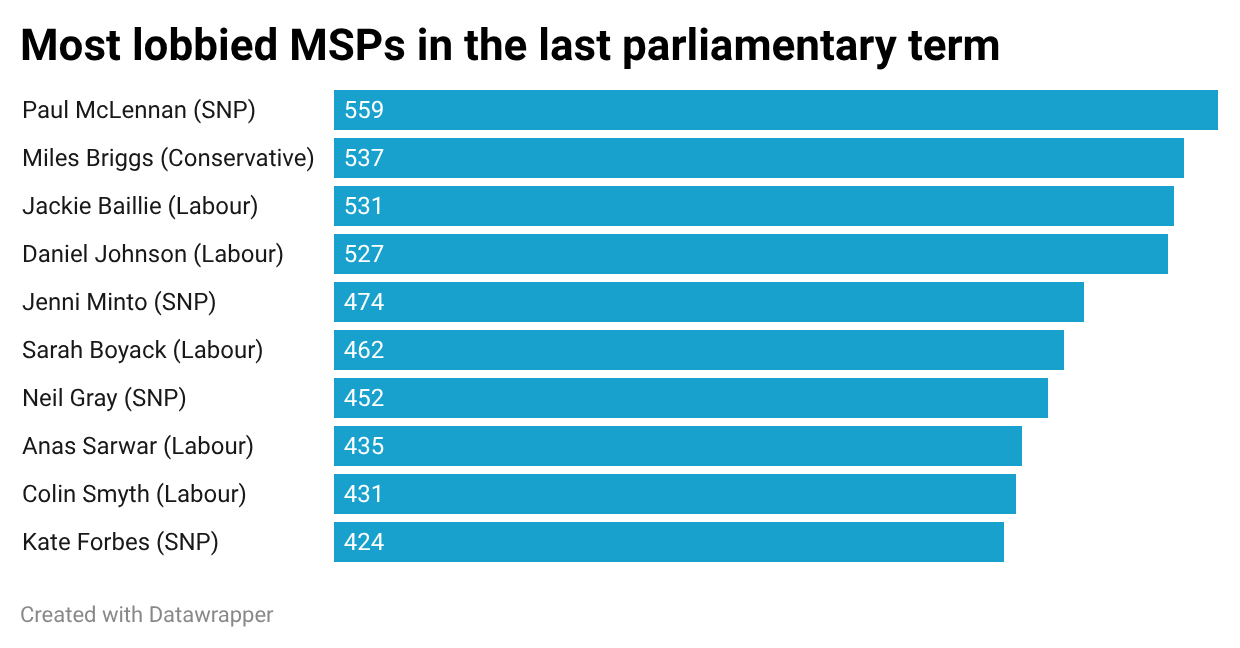
In contrast we found dozens of high-end, intimate dinners, hosted in the name of corporate interests, allowing chief executives of global companies uninterrupted access to politicians. Only a handful of charities lobbied politicians over dinner. Not analysed were the rounds of after dinner speeches by politicians at corporate events, which also feature on the register.
“It's long been established that lobbying favours the better off,” says James Mitchell, professor of public policy at Edinburgh university. “Equality of access may exist in theory but in reality lobbying requires resources.”
And this is where another important gap in the lobbying register is exposed. Financial spend is not declared. “If we were able to see how much was being spent both overall across lobbying activity and where the instance of lobbying required financial outlay, the quality of the engagement and the investment prepared to be made would be clearer,” Mitchell adds.
While reporting on lobbying spend is not widespread, registers in both Germany and the US mandate it.
Lobbying on energy
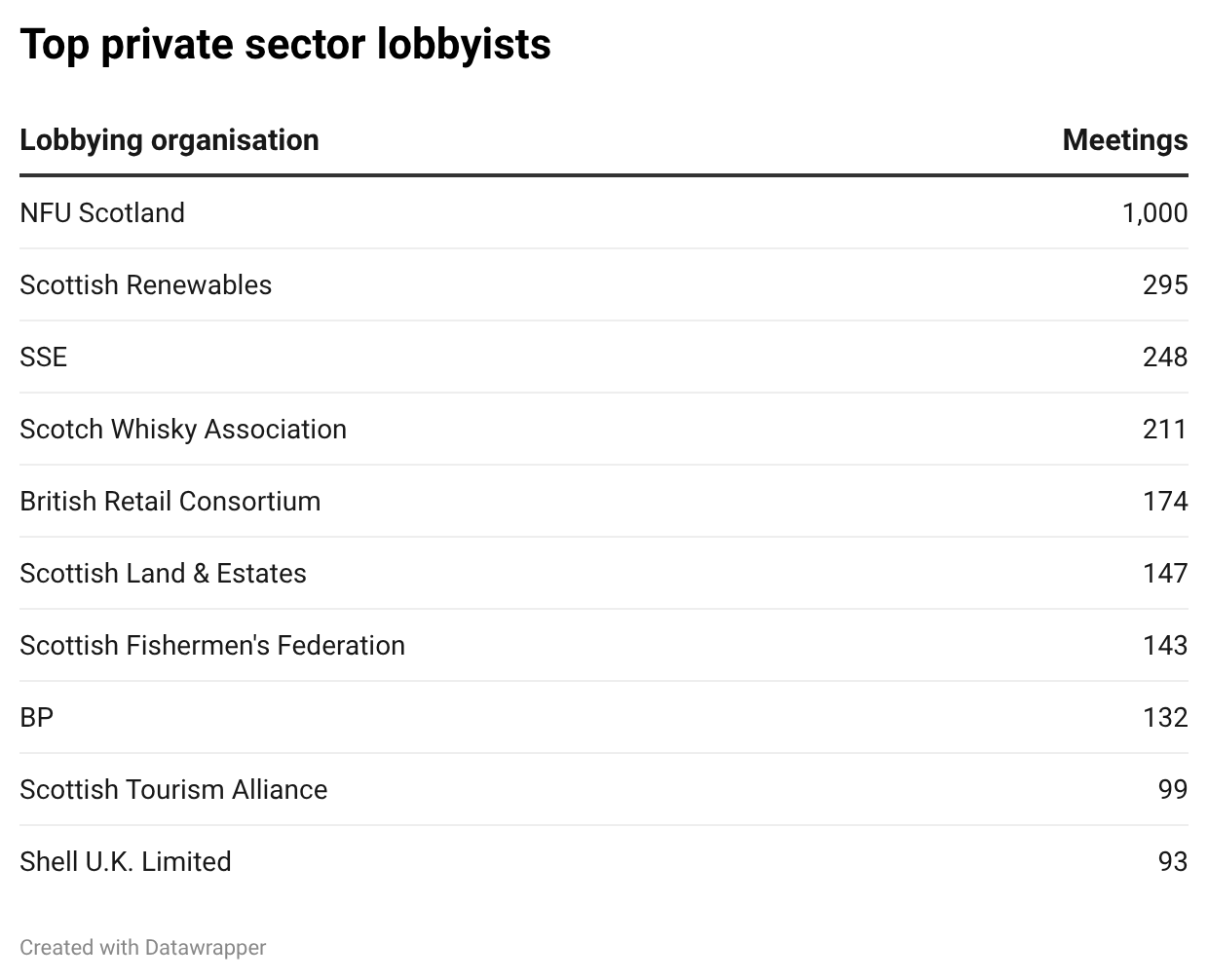
Lots of corporate lobbying last year revolved around energy, despite it being a reserved issue. In total, over 2,500 lobbying meetings were logged by energy, renewables or oil and gas companies in the last parliamentary term.
Many fossil fuel companies have called on politicians to support the removal of the energy profits levy, such as Harbour Energy whose representatives met with the first minister in October 2025 and told him it was looking for “ongoing support from the SNP and Scottish Government in relation to the removal of the current energy profits levy”.
The Scottish Government has indeed continued to lobby the UK Government on its removal. Under Nicola Sturgeon, the government supported the energy profit levy though it has been argued that the parameters have since changed. BP, which clocked up 132 lobbying meetings over the last Parliamentary term, has delivered similar messaging. Both organisations – along with Harbour Energy – have been clients of True North.
The energy sector was also prolific in terms of high-end lobbying. Private dinners hosted by – or on behalf of – the energy sector, include one held by Charlotte Street Partners – the PR firm founded by former SNP advisor and MSP, Andrew Wilson and communications expert Malcolm Robertson. Màiri McAllan MSP, then cabinet secretary for net zero and energy, was amongst guests at Glasgow’s Malmaison hotel.
In September 2023 True North hosted a dinner at the five-star Marcliffe Hotel and Spa in Aberdeen – a favourite spot of the late Alex Salmond – and invited first minister Humza Yousaf. Ian Wood was also in attendance, lobbying on behalf of the Energy Transition Zone (ETZ), as well as representatives from Shell and BP.
At another dinner in March 2025, also at the Marcliffe but this time hosted by ETZ, deputy first minister Kate Forbes was lobbied by renewable energy companies including Norway-based wind developer, Fred Olsen Seawind. Last month the renewables company reached a deal to take over ownership of the Muir Mhor windfarm.
Also at the high end hotel was renewables company Floatation Energy, whose parent company is Japan’s Tokyo Electric Power company. It had put in an application for wind farm consent the month before the dinner.
The company attracted controversy in 2024 when it emerged it had donated £30,000 to SNP Westminster leader and Aberdeen MP Stephen Flynn – now standing as an MSP – before he lobbied ministers on the company’s behalf. He said the donation was properly declared.
Floatation Energy also hosted its own dinner for ministers at Aberdeen’s Maryculter House, a historic heritage hotel which boasts exclusive private dining rooms. Until September 2025 the company's chief executive was Lord Nicol Stephen, a former deputy first minister.
Back in Glasgow, True North hosted a dinner at high-end restaurant and city institution, the Ubiquitous Chip, during the Labour Party conference in February 2025. Over food and drinks, MSP Sarah Boyack heard from energy companies including Shell, SEN Transmission and ETZ. They lobbied in favour of carbon capture and the “role of oil and gas to meet energy demand through the transition” to net zero. Boyack has been one of Scottish Labour’s strongest voices on the environment.
A spokesperson for True North Advisors told The Ferret it was privileged to work with ONE and ETZ, “two fantastic not-for-profit organisations seeking to diversify the economy of the north east of Scotland – ensuring it is an attractive location for investment in renewable energy, food and drink, life sciences and digital technology”.
“Between them, these organisations are driving entrepreneurial growth, bringing investment to the region, supporting new jobs and training opportunities,” they added, insisting all regulated lobbying activity is recorded and published in line with law.
Arden Strategies, founded by former Scottish Labour leader Jim Murphy, has also lobbied hard for renewable companies, with former SNP MP Stewart McDonald hosting nine lunch and other meetings with senior SNP and opposition politicians on behalf of Canadian Wind company Boralex, which moved into the UK in April 2025. It did not respond to a request for comment.
Aviation, pharmaceutical and other industry lobbying
The aviation and defence sectors were also represented, with high value lobbying dinners held by defence firms Babcock International Group and Boeing, as well as Easyjet.
Other dinners held over the last parliamentary term include those hosted by the pharmaceutical industry, with GlaxoSmithKlein holding two dinners at Edinburgh’s Wedgewood Restaurant, which has tasting menus for £85 per head before wine pairings – one for Labour and one for Tory MSPs. A similar dinner was held at Edinburgh’s Marriott Hotel with minister Richard Lochhead.
Less than a year later Scottish Enterprise announced a £35m fund to help life sciences companies “scale up and stay in Scotland”. Overall the pharmaceutical industry lobbied 647 times over the parliamentary term according to The Ferret’s analysis.
The financial industry, which lobbied politicians and special advisors a total of 756 times over the same period, also hosted a variety of dinners including at Edinburgh’s prestigious Prestonfield Hotel.
Others were hosted by energy company Centrica, Glenmoragie, and the Fisherman’s Federation, while the Scottish Countryside Alliance held dinners about deer management, grouse licensing and hunting with dogs. A handful of dinners hosted by charities include one organised by a consultant for the Energy Saving Trust for Scottish Green MSP Patrick Harvie at the upmarket Buttery in Glasgow.
The influencing game
Organisations contacted by The Ferret stressed lobbying was simply a part of the democratic process and carried out in strict accordance with the regulations. The Scottish Government said calls for lobbying spend to be logged were for political parties to answer. An SNP spokesperson said: "The lobbying register is a matter for the Scottish Parliament, which has clear guidelines in place."
But campaigners said corporate motivations should be more closely questioned. “Corporate lobbyists are motivated by increasing profits for their shareholders,” added Transparency International UK’s Juliet Swann. “I think a lot of the responsibility lies with decision makers to be more curious about the motivations of who they are listening to and seeking out alternative perspectives.”
The lobbying register data over the last parliamentary term, while partial, highlighted interesting patterns around influencing work. We found individual companies, trade organisations and media stories appearing at similar times used similar messaging, with individual conversations then reinforced by roundtable discussions where several companies lobbied on the same point at once.
For example when the hospitality industry lobbied the Scottish Government on the need for business rate reform at the end of last year, lobbying notes in the register from UKHospitality Scotland were echoed in media coverage and by politicians raising the issue in debates.
Swann added: “I think the influence landscape is about using multiple fronts of influence. Corporations are often lobbying as themselves, through commercial lobbyists, and via trade associations – add in press stories, think tank reports and academic papers repeating that narrative and you start to create a bubble that is hard for less well-resourced organisations to burst.
“Other trends we see are the sponsoring of large parts of party conferences and hosting or sponsoring events. Sometimes these types of tactics go under-reported.”
Lobbying loopholes
Stirling university’s Will Dinan claims high-end dinners show the tip of the iceberg of contact. “I think it’s pretty obvious that there’s much that goes unseen,” he says. “Entertaining and hospitality is a proven way of building relationships. That’s the kind of setting where there can be follow-up through phone calls or emails and the detail of all of that, and what follow-up requests might be made, goes unrecorded in the current system.”
Good governance matters, he says, because that way undue influence on decisions about issues – from the privatisation of our healthcare to supply chains in the burgeoning renewables sector – should be possible to challenge.
Lobbying can have real world impacts, says Swann: “One could argue that progress is held back on issues of social importance like climate change, health inequalities and economic justice because vested interests hold the ear of decision makers, access to policy makers is restricted, power is held behind closed doors by small elite groups and scrutiny of decision making is challenging and under-resourced.”
She says there are many politicians who stick to their policies and put the public first, and “that should be applauded”. But while she supports calls for transparency to be increased, especially in terms of value, she also queries whether that is enough on its own. The World Health Organisation’s guidelines on tobacco and lobbying – which mean it is tightly regulated – could be copied for other sectors, for example, added Swann.
Some changes may be coming. In the last parliamentary session, the standards, procedures and public appointments committee commissioned an evaluation of the Lobbying (Scotland) Act 2016.
"The findings of the evaluation identified a number of changes that could be made to the existing act," a spokesperson for the Scottish Parliament told The Ferret. "The committee recommended that consideration of such changes should be an early priority for its successor in the next parliamentary session.”
However, a requirement to disclose financial details would require legislation change.
“And where are the champions of open government when it comes to that reform?” asks Dinan. “I think we can all see the democratic benefit. We shouldn’t wait for the next scandal before we take action.”
Read the details of the private dinners we featured
Independent journalism isn’t free, but it is essential.
We investigate power, money, and decisions made in public view. Reader support protects our independence and gives us time to do work that others won’t.

Read next

Anti-immigration activists from England due to travel to Glasgow for protest, claims "patriot" group
Tensions are high in Glasgow following a series of protests over alleged sex crimes by migrants. Police and anti-racism groups fear extremists could inflame the situation.

The Guga Hunt: Why a centuries-old Hebridean tradition is facing renewed scrutiny
The Ferret did a deep dive to explain why a bird cull on Lewis dating back centuries is causing outrage amid claims it's a "blood sport"

Did Scottish ministers “rewrite history” over Israel meeting?
The Scottish Government changed key parts of the official record of Angus Robertson’s controversial Israel meeting after a backlash, raising questions about government secrecy.


Reform UK activist claimed to know that Northern Ireland migrants would be targeted
Concerns have been raised after a Reform UK campaigner claimed he knew in advance that migrants in Belfast would be targeted following the heinous attack on Stephen Ogilvie. Reform UK said it has “repeatedly and unequivocally condemned violence, intimidation and criminal damage”.