

Sepa branded ‘toothless’ after salmon farm accused of 15 environmental breaches
The Scottish Government’s green watchdog sent seven letters over three years alleging multiple breaches at a fish farm – and then issued a final warning letter.
The Scottish Government’s green watchdog sent seven letters over three years alleging multiple breaches at a fish farm – and then issued a final warning letter.

This US-style right-wing political pressure group keeps its funders a secret. Its members have helped man Scotland’s anti-migrant and asylum demonstrations.

Adult adoptees are calling for access to genetic testing to address the ‘health gap’ caused by their lack of information about genetically inherited conditions.
Scotland's information watchdog has ordered the release of hidden details of Angus Robertson’s meeting with an Israeli diplomat after a lengthy freedom of information battle.


Secret details of Angus Robertson’s much-criticised meeting with an Israeli diplomat are to be released after a near two-year freedom of information battle by The Ferret.
Robertson, who was the Scottish Government’s external affairs secretary, met Israeli deputy ambassador Daniela Grudsky in August 2024, sparking a political backlash as Israel faced international condemnation for its war on Gaza.
We revealed last year that Robertson controversially described Scotland as a “critical friend” of Israel at the meeting, after parts of the minutes were released following a freedom of information (FoI) request.
But the Scottish Government hid sections of that document, arguing that making them public could damage UK relations with Israel and affect how the government operates.
Now, after an appeal by The Ferret, the Scottish Information Commissioner (SIC), David Hamilton, has ordered the hidden details to be made public after concluding they had been “wrongly withheld”.
The Scottish Government has until 15 June to publish the information, but opposition politicians have called for it to be released to the public ahead of next week’s election.
We were only able to persevere with this story because of the support of our paying members.
They help us get results, and so can you.
The Ferret first requested the official record of the meeting in August 2024, shortly after it took place. But the Scottish Government refused to release it – a decision we challenged with the information watchdog.
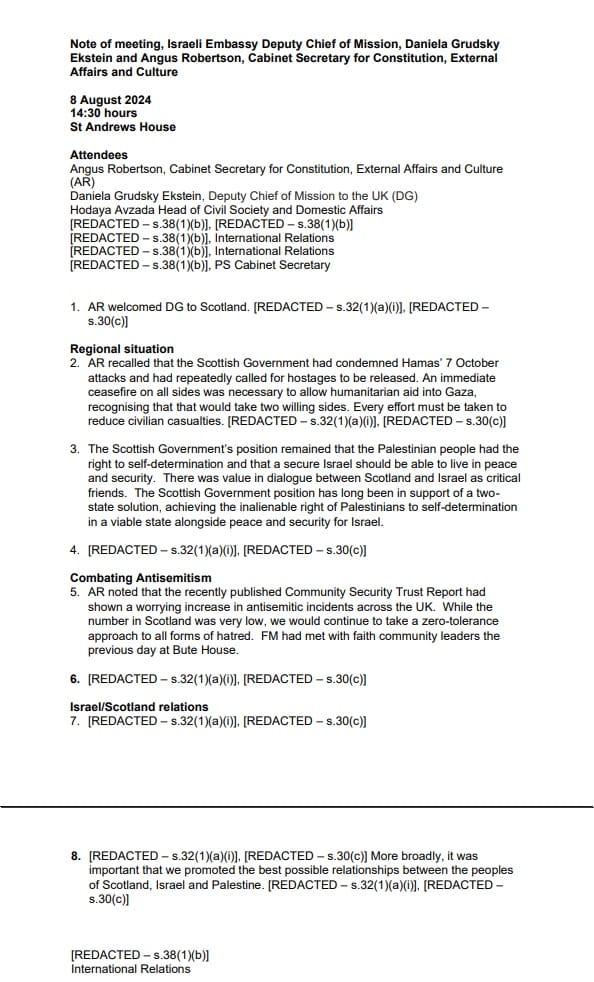
After that appeal was upheld by the SIC last year, a partial version was released. But sections – including on the situation in the Middle East, antisemitism, and the relationship between Scotland and Israel – remained redacted.
Hamilton’s decision means these secret parts will now be made public. A first draft of the minutes – which was revised after a request by Robertson’s office – will also be published.
Ministers had claimed releasing the material could “prejudice substantially relations between the UK (including Scotland) and the state of Israel” as well as the “effective conduct of public affairs”.
They made a range of arguments to support that position in submissions to the commissioner, which are set out in Hamilton's decision.
These included concerns about Israel’s possible reaction to the release of the material.
The Scottish Government argued the country was “prone to take significant and serious diplomatic responses when provoked” and that its behaviour could be “highly unusual” and “unpredictable”. It sought the views of the Israeli government on the FoI request, and they objected to the release of the information.
The Scottish Government also consulted the UK Foreign Office which said publishing the material against Israel’s wishes was “highly likely to see a negative response”.
Disclosure could affect the “Jewish community” and the Scottish Government’s “relationship with the only Jewish state in the world”, it argued.
Ministers also claimed that releasing the information would generate “widespread media attention” and lead “other foreign governments to consider the nature and substance of their contact with the Scottish Government”, if they believed discussions would not be confidential.
But Hamilton concluded that the risk to relations with Israel and the conduct of public affairs did not meet the threshold required to withhold the information, and said he did not view the material as "particularly sensitive".
The Scottish Government told us it had received the decision and will respond in due course. It has 42 days to appeal the SIC’s decision with the Court of Session, Scotland's supreme civil court, which sits in Edinburgh.
The meeting itself became a flashpoint after Grudsky posted a photograph of her and Robertson smiling together at St Andrews House on social media.
The post said they had discussed “unique commonalities” between Israel and Scotland and cooperation in “the fields of technology, culture and renewable energy”. These issues are not mentioned in the partial minutes released so far.
Robertson later apologised that the discussion had not solely focused on a ceasefire in Gaza.
The backlash led ministers to rule out further meetings with Israel until there was “real progress” towards peace, and prompted calls for Robertson to resign.
However, documents released to The Ferret last year showed there was a wider effort across government in the months leading up to the meeting to engage with Israeli officials.
The Scottish Government contacted the Israeli embassy in June 2024, the month after John Swinney became first minister, to arrange a meeting between Swinney and then Israeli ambassador to the UK, Tzipi Hotovely.
Israeli officials also enquired about meeting deputy first minister Kate Forbes, but were told that Robertson, as external affairs secretary, was the “right interlocutor” for the talks.
 Paul Dobson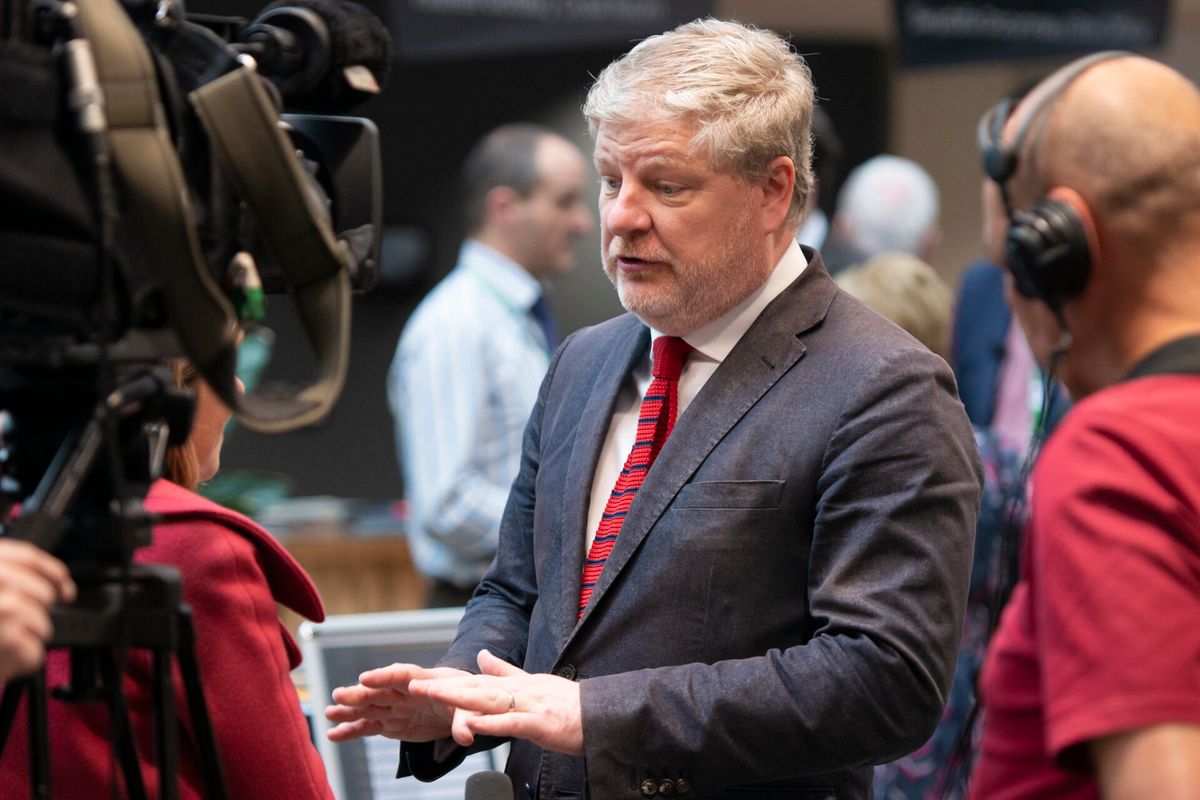
The Scottish Greens’ spokesperson on external affairs, Patrick Harvie, said the “photo of Angus Robertson smiling alongside the deputy ambassador rightly shocked a lot of people, and we all deserve to know what they had said to one another”.
“It is time for them [the SNP] to finally come clean and it is right for them to do so ahead of next week’s election,” Harvie continued. “Scotland should not be any kind of friend to Israel’s government, which has inflicted genocide against Palestinians.”
Former Labour MSP, Mercedes Villalba, said it should not have “taken an appeal from The Ferret for these minutes to be released”. “It speaks volumes that when caught out, ministerial instinct was to cover tracks to protect cosy relations with a regime accused of genocide, rather than open up to public scrutiny,” she added.
“The Scottish people oppose what Israel is doing, and have a right to know the full scale of our governments’ involvement now, not after the election.”
Neil Cowan, Amnesty International’s programme director in Scotland, claimed Hamilton’s decision was “welcome and significant”. “Amnesty has repeatedly challenged the Scottish Government on a lack of transparency in its international work, but ministers have continued to fight the disclosure of this information, which belongs in the public domain,” Cowan said.
The SNP was asked to comment but said this was a matter for the Scottish Government.
Help us keep digging.
If this reporting mattered to you, you can help fund the next one. The Ferret is independent, member-owned investigative journalism, backed by readers who want accountability in Scotland.

The Scottish Government’s green watchdog sent seven letters over three years alleging multiple breaches at a fish farm – and then issued a final warning letter.

This US-style right-wing political pressure group keeps its funders a secret. Its members have helped man Scotland’s anti-migrant and asylum demonstrations.

Adult adoptees are calling for access to genetic testing to address the ‘health gap’ caused by their lack of information about genetically inherited conditions.

We looked at inspection reports from the body which certifies “highest standard” farms with a public-facing ‘green tick’ — and found there have been breaches of its rules at dozens of fish farms.
