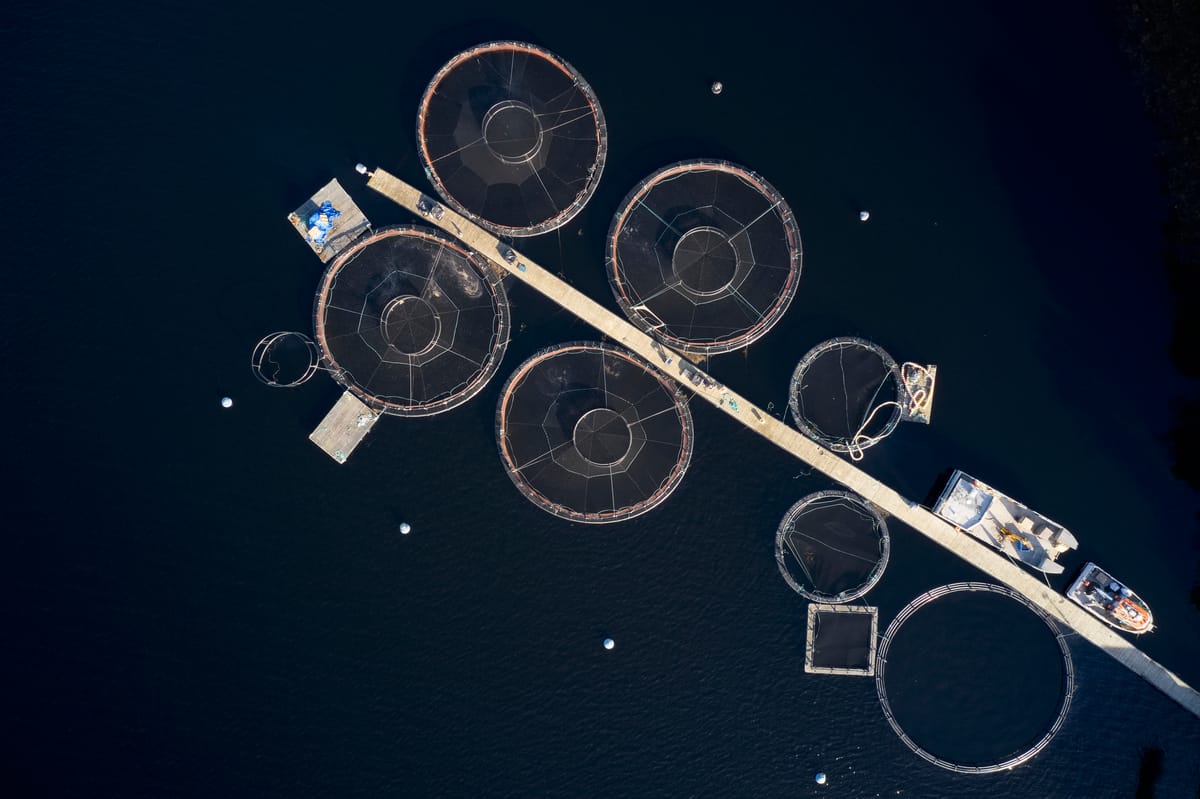
Investigations into allegations of poor fish welfare at salmon farms by the UK Animal and Plant Health Agency have risen by more than ten times in six years, while site inspections have decreased.
New allegations at Stirling Castle dating back eight years have emerged following a string of complaints about its custodians, Historic Environment Scotland, in recent months.
‘Weak’ salmon farm watchdog: 100 investigations and just two warning letters
Investigations into allegations of poor fish welfare at salmon farms by the UK Animal and Plant Health Agency have risen by more than ten times in six years, while site inspections have decreased.
The UK Government’s animal welfare watchdog has been accused of being “embarrassingly weak” after new figures revealed that it has investigated more than 100 complaints alleging poor fish welfare at salmon farms – but sent just two warning letters.
Official information released to The Ferret also show that salmon farm investigations by the UK Animal and Plant Health Agency have risen more than tenfold, from five to 57 in the last six years.
But over the same period, the number of occasions on which investigators actually visited farms to check on fish welfare fell from five in 2020 and seven in 2021, to four in 2025.
Tens of millions of farmed salmon have died prematurely from diseases, lice and other causes since 2020, as well as at least seven million fish used to eat the lice that can infest the salmon.
Campaigners pointed out that the fish must have suffered before they died, and attacked the animal agency for putting “profits ahead of ethics”. It’s a “national scandal”, they said, that “tarnishes” Scotland’s reputation on animal welfare.
According to the Scottish Greens, the current system allowed regulators to take no action, even when millions of fish were “diseased and dying”. This would not happen in any other type of farming, they said.
The Animal and Plant Health Agency (APHA) refused to say which salmon farms had received warning letters, or what they contained. It stressed that it treated all suspected cases of poor welfare “seriously” and worked closely with other public bodies on “triage and assessment”.
This story exists thanks to you.
The Ferret doesn't answer to advertisers, owners, or paywalls. We answer to you, our readers and over 2,000 members who support journalism that holds power to account.
Fish welfare at salmon farms is due to be examined at a meeting of the Scottish Parliament’s rural affairs committee on 25 February, as part of a renewed investigation into the industry by MSPs. Amongst those facing questioning will be APHA’s leading vet in northern Scotland, Amy Jennings.
APHA is an executive agency of the UK Department for Environment, Food and Rural Affairs in London, and also works for the Scottish Government. It is responsible for fish welfare and enforcing animal welfare law.
In response to a freedom of information (FoI) request by The Ferret, APHA released figures on its investigations into complaints about fish welfare at salmon farms. These showed that there had been a total of 104 investigations between 2020 and 2025.
But APHA only took enforcement action for breaches of animal welfare rules twice, sending one warning later in 2023 and another in 2025. In response to a second FoI request, the agency refused to give any further details as this would “prejudice the commercial interests” of the companies involved.
“APHA can confirm that the nature of the enforcement action in both cases was a warning letter, and no subsequent action or outcome was necessary,” the agency said.
Year
Complaint investigations
In-person site visits
Warning letters
2020
5
5
0
2021
11
7
0
2022
3
3
0
2023
9
3
1
2024
19
2
0
2025
57
4
1
Totals
104
24
2
Source: Animal and Plant Health Agency in January and February 2026
The figures also revealed that the number of salmon farm investigations by APHA rocketed from five in 2020 to 57 in 2025. But over the same period the number of in-person site visits fell from five to four.
In 2025, APHA did conduct what it called “remote” inspections of nine other fish farms, but these did not include in-person visits. There was also one “remote” inspection in 2021.
Coastal Communities Network Scotland, which brings together more than 30 groups concerned about the marine environment, pointed out that Scottish Government figures showed that 21 million salmon died in sea cages in 2022, before they were due to be killed and marketed.
“APHA is failing to ensure that farmed fish live good lives, without suffering unnecessarily,” said the network’s fish farming spokesman, John Aitchison.
“This is a national scandal, tarnishing Scotland’s reputation as a country that cares about animal welfare, and showing that we put profits ahead of ethics.”
Another member of the network, Dennis Archer from Friends of Loch Creran, accused APHA of failing to properly look for poor fish welfare. “Public complaints are not thoroughly investigated,” he said. “The system protects fish farmers, not fish.”
The campaign group, Animal Equality UK, claimed the salmon farming industry was facing “scandal after scandal” because fish welfare regulation was so poor. “While complaints have soared, the regulator’s response has been embarrassingly weak,” said the group’s director, Abigail Penny.
“By any objective measure, the current regulatory framework is failing and needs an urgent overhaul. Scotland must press pause and halt further expansion of the salmon farming industry.”
According to the Highland Green MSP, Ariane Burgess, the figures revealed by The Ferret raised "very serious concerns about the lack of enforcement”.
"The current system allows regulators to stand back and take no action when millions of fish are diseased and dying,” said Burgess, a member of the Scottish Parliament’s rural affairs committee, which is re-examining salmon farming.
“If this were happening in any other type of farming, there would be immediate scrutiny,” she added.
“How can we expect people to have confidence in eating farmed salmon when the way it is produced is clearly not up to the high animal welfare standards they expect?”
The Animal and Plant Health Agency insisted it was unable to comment on individual cases. "We treat all reports of suspected cases of poor welfare at salmon farms seriously and all are assessed by our vets,” said a spokesperson.
“We work closely with local authorities and the Scottish Government’s Fish Health Inspectorate to manage each case through our standard process of triage and assessment.”
Salmon Scotland, which represents salmon farming companies, said that the industry was subject to more than 1,600 audits and inspections every year, and operated under “strict welfare law”.
"Scottish salmon is one of the most highly regulated food sectors in the world,” claimed a spokesperson. "No one cares more about these fish than the people who look after them, and survival rates, which are voluntarily published, remain high."
Help us keep digging.
If this reporting mattered to you, you can help fund the next one. The Ferret is independent, member-owned investigative journalism, backed by readers who want accountability in Scotland.
Rob has more than 40 years’ experience specialising in reporting on environmental issues. He has co-authored three books about nuclear power, produced radio and television programmes. He likes muckraking.
New allegations at Stirling Castle dating back eight years have emerged following a string of complaints about its custodians, Historic Environment Scotland, in recent months.
Sir Peter Mathieson appears to have confirmed he is being paid for a board role at a university spin-off at the same time as many staff face uncertainty about their futures.
Scottish ministers have been privately urged to back plans for a golf course on a coastal wildlife site. This has been condemned as “backdoor lobbying that tries to bypass the rules”.