

Claim 'abortion to birth' is now legal in the UK is Mostly False
Changes to abortion law in England and Wales have been misrepresented on social media.
Changes to abortion law in England and Wales have been misrepresented on social media.
Climate change is causing rising sea levels and coastal erosion and 109 Scottish golf courses are at risk. We examined the issue as part of Green drive: Golf and the environmental crisis – a special Ferret series on golf and the environment.
The Ferret exposed the extreme views of Reform UK’s Scotland’s candidates before Nigel Farage promised to improve his party’s “poor” vetting processes, but many of them have been re-selected to fight the Holyrood election.
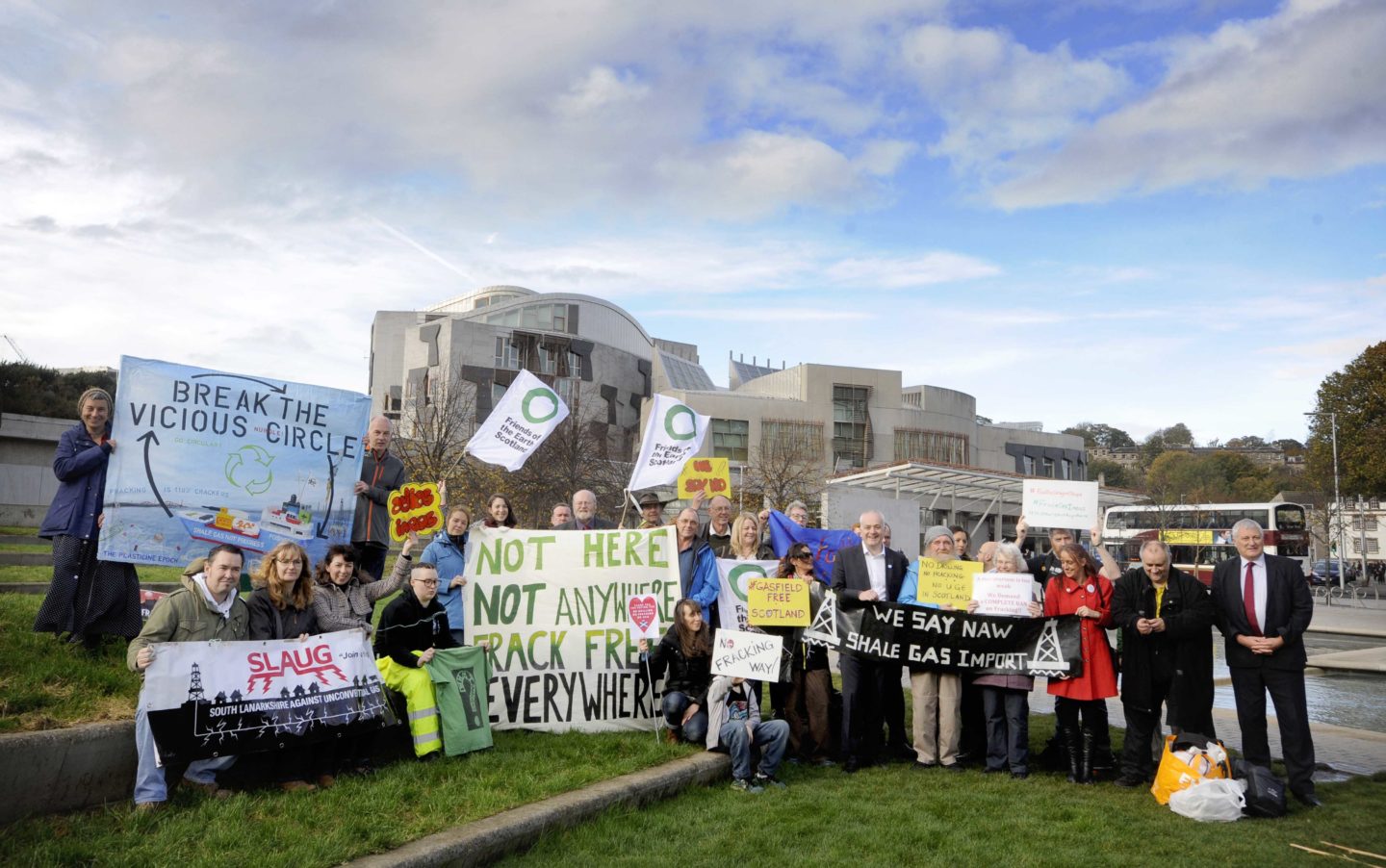
The fracking industry has been condemned by an international tribunal for harming humanity, violating human rights and damaging nature.
The Permanent Peoples’ Tribunal, set up in Italy in 1979 to defend human rights, has investigated fracking and issued a preliminary statement accusing companies and governments of failing in their duties.
The tribunal took key evidence from Scotland, where the Grangemouth petrochemical giant, Ineos, has taken the Scottish Government to court over its “effective ban” on fracking. A verdict is awaited.
A panel of ten judges from eight countries held online hearings on fracking over five days in May. They concluded that the rights of people and nature were “subjugated to the financial interests of states and corporations” as part of a “systemic crime architecture.”
[aesop_quote type=”block” background=”#282828″ text=”#ffffff” align=”center” size=”1.5″ quote=”The industry has failed to fulfil its legal and moral obligations.” cite=”Permanent Peoples’ Tribunal” parallax=”off” direction=”left” revealfx=”inplace”]
The judges described the evidence they heard as consistent, and based on hundreds of independent reports. “The industry has failed to fulfil its legal and moral obligations,” they said.
“The processes of fracking contribute substantially to anthropogenic harm, including climate change and global warming, and involve massive violations of a range of substantive and procedural human rights and the rights of nature.”
The judges also criticised governments across the world for failing to regulate the industry and protect communities and nature. “They have failed to act promptly and effectively to the dangers of climate change that fracking represents,” they said.
The tribunal, which is based in Rome, seeks to uphold the Universal Declaration of Peoples’ Rights agreed in Algiers in 1976. Its main aim “is to contribute to the struggle of peoples for their self-determination and the prevention, assessment, judgment and reparation of their fundamental rights”.
One of the lawyers who gave evidence was Lisa Mead, who is based in Moray and director of the Earth Law Alliance, an environmental group. “We gathered and submitted a mass of evidence showing the negative impacts on nature and on human health,” she said.
“Fracking and other forms of unconventional oil and gas extraction, are highly dangerous and damaging activities. Humans and nature are suffering severely negative consequences as a result, particularly in the USA, Canada and Australia.”
Mead made submissions on climate pollution, toxic waste water and risks to the natural environment. She accused the fracking industry of making money at the expense of people’s health and “risking our future on this planet.”
She praised the Scottish Government for extending its moratorium on fracking, and described its approach as “an exemplar” for other countries. “I just wish that the UK government had the sense to follow the same line,” she added.
[aesop_quote type=”block” background=”#282828″ text=”#ffffff” align=”center” size=”1.5″ quote=”The tribunal decision at this stage vindicates the wise actions of the Scottish Government.” cite=”Professor Andrew Watterson, University of Stirling” parallax=”off” direction=”left” revealfx=”inplace”]
Two experts from the University of Stirling also gave evidence to the tribunal. “The arguments of the UK industry about the alleged safety of fracking do not stand up to scrutiny,” said professor Andrew Watterson, head of the university’s occupational and environmental health research group.
“The tribunal assessment demolishes the assertion, never based in fact, that there was some sort of scientific and research consensus supporting the fracking industry claims that it would not damage either our climate or public health.”
He added: “The tribunal decision at this stage vindicates the wise actions of the Scottish Government in their careful deliberations about fracking and their decision not to support fracking in favour of protecting public health.”
Will Dinan, an academic at Stirling University and director of the monitoring group, Spinwatch, accused the industry of a “moral and legal failure”. The Scottish Government was likely “largely excused” from criticism, he said.
Andy Gheorghiu, policy advisor with the campaign group Food & Water Europe, called on Scottish ministers to reject fracking licences under newly devolved powers.
He said: “A court of international importance has confirmed that the Scottish Government was on the absolutely right path to introduce an indefinite moratorium on fracking and defy the bully tactics of Ineos.”
Ineos is demanding multi-million pound compensation from taxpayers for the Scottish Government’s decision not to allow fracking. Lawyers for the government argued in court that a ban had not yet been technically imposed.
Challenge to Ineos multi-million pound claim for fracking ban
The Scottish Government stressed that its “preferred position” was not to support the development of unconventional oil and gas. “This position is subject to a strategic environmental assessment,” said a government spokesperson.
“It would be inappropriate to comment further during the judicial review process.”
UK Onshore Oil and Gas (UKOOG), which represents fracking companies, highlighted a 2014 report by a Scottish Government panel of experts. It concluded that Scotland’s regulatory system was “sufficiently robust” to manage fracking, according to UKOOG’s chief executive, Ken Cronin.
“We would suggest that is a better guide to environmental safety,” he said. “Being able to heat your home, cook your food and use a whole range of manufactured goods produced by oil and gas are human rights too.”
Ineos did not respond to requests to comment.
[documentcloud url=”http://www.documentcloud.org/documents/4501071-PPT-Statement-Post-Session-HR-FR-CC-4-6-18.html” responsive=true]
Photo thanks to Friends of the Earth Scotland and Colin Hattersley. A version of this story was published in the Sunday Herald on 10 June 2018.


Climate change is causing rising sea levels and coastal erosion and 109 Scottish golf courses are at risk. We examined the issue as part of Green drive: Golf and the environmental crisis – a special Ferret series on golf and the environment.

Britain Remade has appointed two directors from a lobbying firm which represents EDF, the owner of Scotland’s last nuclear power station.

Huge volumes of sewage sludge have been used to fertilise Scottish farmland. Studies show it contains microplastics, forever chemicals and cancer-linked pollutants.

Scottish ministers have been privately urged to back plans for a golf course on a coastal wildlife site. This has been condemned as “backdoor lobbying that tries to bypass the rules”.


