We asked about the environmental records of Scotland’s 25 best golf courses. The US president’s resort in the north east was the only one to breach its licence in recent years.
Climate change is causing rising sea levels and coastal erosion and 109 Scottish golf courses are at risk. We examined the issue as part of Green drive: Golf and the environmental crisis – a special Ferret series on golf and the environment.
One of the world’s last remaining natural paradises is being damaged by the rapid expansion of salmon farming in Chile, scientists and environmentalists have warned.
The pristine fjords of Chilean Patagonia on the southern tip of South America are increasingly being exploited by fish farming companies, putting penguins, albatross, whales and other wildlife at risk, they said.
“Salmon farming, at least done in the way it is done in Chile now, has a huge environmental impact,” stated Alan Friedlander, a researcher at the University of Hawaii and science director of the National Geographic’s Pristine Seas programme.
“Endangered species like humpback whales, orcas, sea otters, endemic Chilean dolphin, cold water corals, albatross, penguins are all threatened by salmon farms.”
According to Friedlander, the most direct impact was from salmon faeces, dead fish and uneaten feed. They polluted the fjords and deprived them of oxygen, creating “dead zones”, he told The Ferret.
“The stocking density is quite huge, and as a result in the past they had virus outbreaks that decimated the populations. To combat the problems with high stocking density they use antibiotics, they use pesticides.”
The Pristine Seas programme has highlighted Chilean Patagonia as a “top priority area” for conservation. This is because “its significance for numerous threatened and endangered species, and its importance for valuable fisheries species.”
Salmon farming on the increase
As in Scotland, the fish farming industry has grown fast in Chile, with millions of salmon now reared in cages scattered along Patagonian fjords. Chilean production has grown an average of 10.4 per cent between 2016 and 2020, when it reached 1.1 million tonnes.
According to the Chilean Fishery and aquaculture national service, in 2021 production in Chilean Patagonia was 938,000 tonnes. The southernmost region, which overlooks the Strait of Magellan and Tierra del Fuego, saw production surge from 28,476 to 134,080 tonnes between 2012 and 2021.
Salmon is Chile’s second largest export after copper. In 2021 the country sent over £4 billion worth of salmon and trout to the United States (44 per cent), Japan (19.9 per cent) and Brazil (12.9 per cent).
Mario Argel, a former employee of the multinational fish farming company, Nova Austral, reckoned that each farm could contain up to 1.2 million salmon. “On the spot, you can clearly see the impact on the seabed due to the deposit of faeces and uneaten salmon feed,” he said.
According to the Chilean campaign group, Terram, the density of salmon in cages is very high. It quoted an aquaculture researcher, Doris Soto, as saying that farms produced an average of 4,500 tonnes of salmon every growing season and deposited 225 tonnes of nitrogen on the seabed “generating a serious environmental impact”.
Endangered species like humpback whales, orcas, sea otters, endemic Chilean dolphin, cold water corals, albatross, penguins are all threatened by salmon farms.
Alan Friedlander, researcher and science director of the Pristine Seas programme
For the first time in July 2022, the Chilean environment regulator, SMA, revoked three licences to Nova Austral for causing “serious environmental damage” by overproduction. SMA has also begun similar proceedings against the Chinese firm, Australis Mar.
“The overproduction of salmon is one of the infractions that most worries us, due to the environmental effects it causes,” said in a press statement SMA’s chief regulator, Emanuel Ibarra.
Salmon farms in protected areas
Chilean Patagonia has seven protected areas, including seas spread over 6.3 million hectares. According to a study by the Austral University of Chile, these areas have 411 fish farming licences, almost all for salmon, with another 134 awaiting approval.
In May 2022 Chile’s newly elected president Gabriel Boric visited the Magallanes region in Patagonia. “There can be no salmon farming industry in marine protected areas,” he said.
But environmentalists fear that the government lacks the strength and will to reduce the number of farms, given the power of the industry and its importance to the Chilean economy.
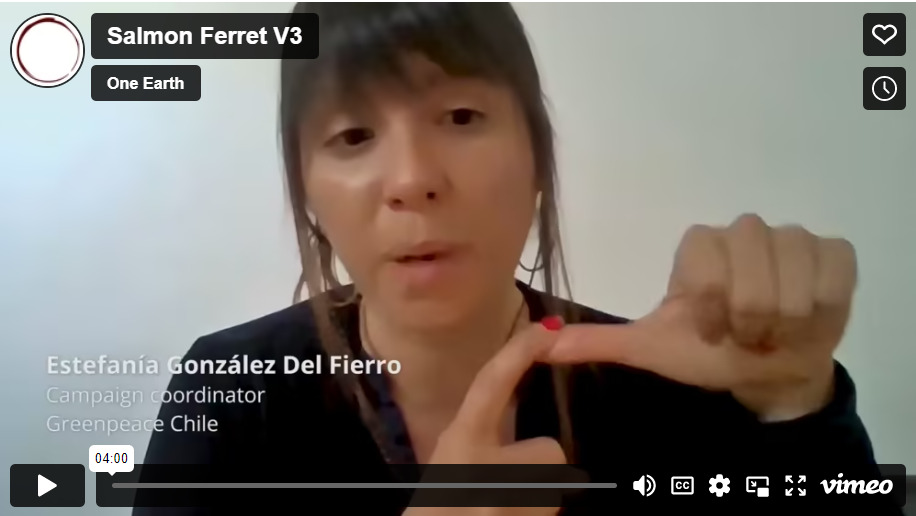
This is our call as Greenpeace: no more expansion of salmon farms in every part of Chile.
Estefanía González Del Fierro, Greenpeace Chile
The industry declined to be interviewed by The Ferret, though it has strongly defended its business. Salmon farming in these areas was “totally legitimate” and every licence had been environmentally assessed, said Carlos Obredet, President of the Association of Salmon Farmers of Magallanes, in a video.
“What the regulation establishes is where the industry can operate, that is determined by the state itself through the appropriate area for aquaculture.”
In July 2021 Argentina banned salmon farms in its neighbouring part of Patagonia because of the environmental damage they caused. Campaigners are now demanding a similar ban in Chile.
“The different protected areas that we have in Chile are not really protected”, Estefanía González Del Fierro, a campaigner with Greenpeace in Chile, told The Ferret. “It is very common to see that salmon farms inside national parks, inside national reserves, inside marine protected areas, and are damaging all this space.”
She was concerned that the Chilean government wanted to move fish farms out of protected areas like national parks to adjacent areas. But that could also damage pristine environments, she claimed.
“We want to put the focus on stopping the expansion. This is our call as Greenpeace: no more expansion of salmon farms in every part of Chile.”
Iris leads our social media and production. She is a freelance journalist and certified sex educator with extensive experience in storytelling, editorial production, and community-centred media. She loves spending time in nature with her camera.
We asked about the environmental records of Scotland’s 25 best golf courses. The US president’s resort in the north east was the only one to breach its licence in recent years.
Climate change is causing rising sea levels and coastal erosion and 109 Scottish golf courses are at risk. We examined the issue as part of Green drive: Golf and the environmental crisis – a special Ferret series on golf and the environment.
Campaigners complained to a government animal welfare watchdog, with videos of badly injured salmon at a fish farm. This prompted a review, but should more have been done?