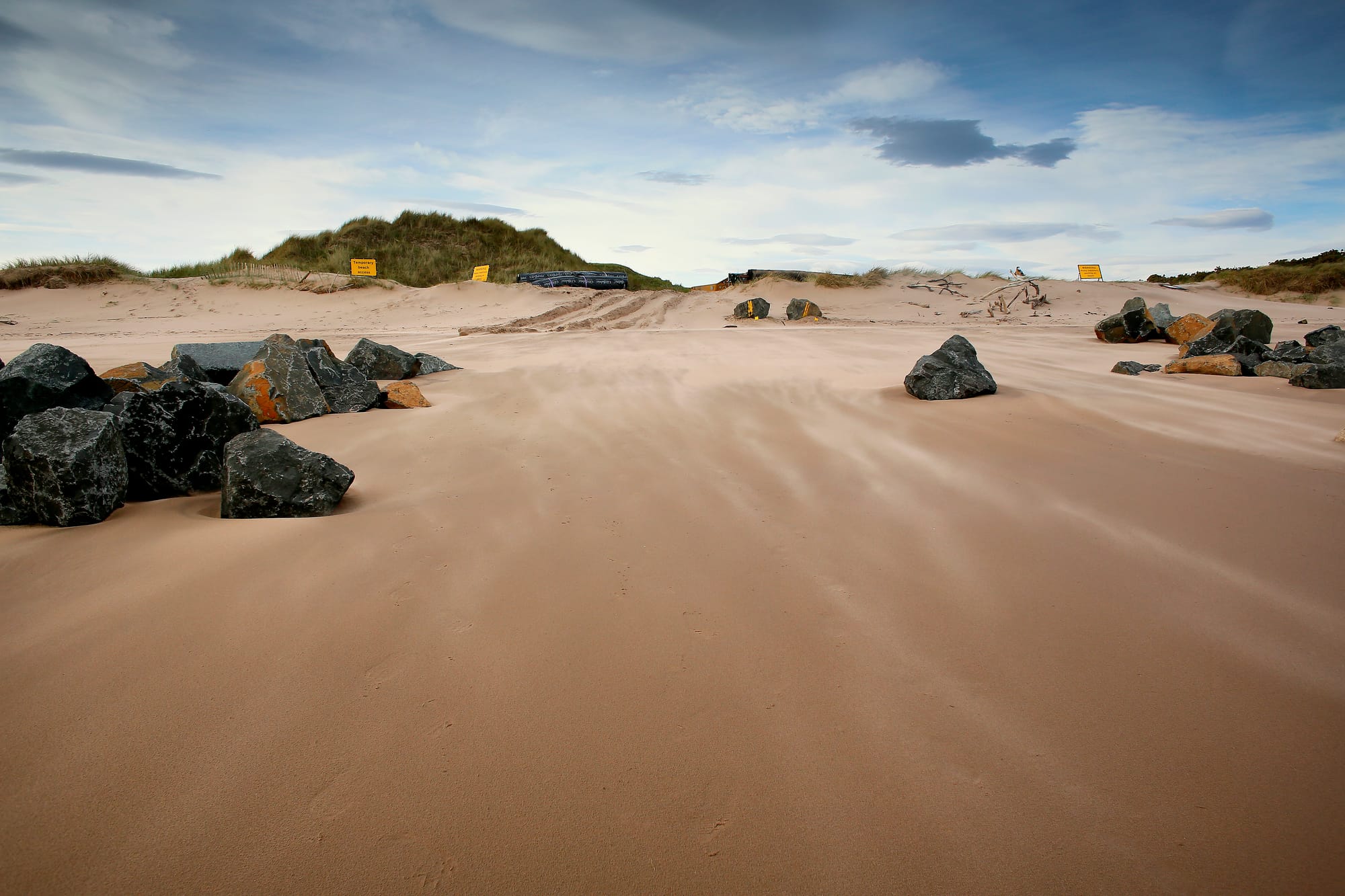
Climate change is causing rising sea levels and coastal erosion and 109 Scottish golf courses are at risk. We examined the issue as part of Green drive: Golf and the environmental crisis – a special Ferret series on golf and the environment.
The Ferret exposed the extreme views of Reform UK’s Scotland’s candidates before Nigel Farage promised to improve his party’s “poor” vetting processes, but many of them have been re-selected to fight the Holyrood election.
Anas Sarwar's party accepted over £7,000 from Stonehaven, a lobbying firm which represents the owner of Scotland's last nuclear power station. Scottish Labour has sought to make nuclear power a battleground in the May election.
Climate change is causing rising sea levels and coastal erosion and 109 Scottish golf courses are at risk. We examined the issue as part of Green drive: Golf and the environmental crisis – a special Ferret series on golf and the environment.
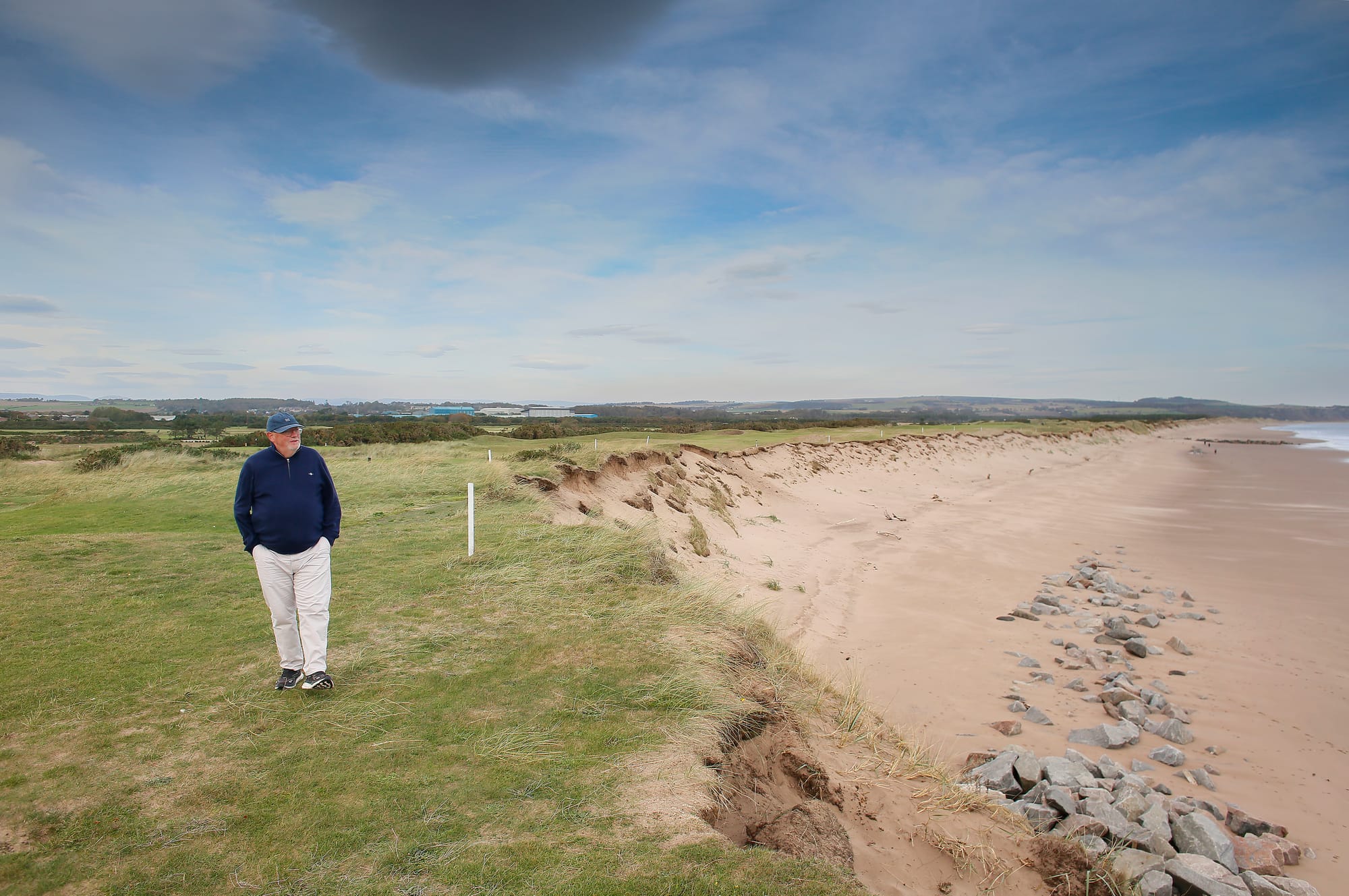
Standing on the edge of Montrose Golf Course on a blustery day, David Wood warns that there’s a steep drop to the beach below, where sand swirls in the wind and white breakers crash onto the shore. “As kids, right up to the 70s, 80s, you could be on the beach here all day – and the dunes went right out there,” he says, pointing to the beach and a frothy North Sea.
We’re on what feels like a small cliff edge as Wood, a member of Montrose Community Council, explains how the sea and wind are sculpting Scotland’s east coast as a result of climate change. He was born in this Angus town and cherishes this beach but the landscape he considers precious is changing fast. The dunes he played on as a boy are eroding rapidly and his home town is at risk of flooding. “There are three things about coastal erosion here,” he says. “There is the loss of vegetation, the height of the sea, and the loss of sand. With climate change we’re losing a lot of sand.”
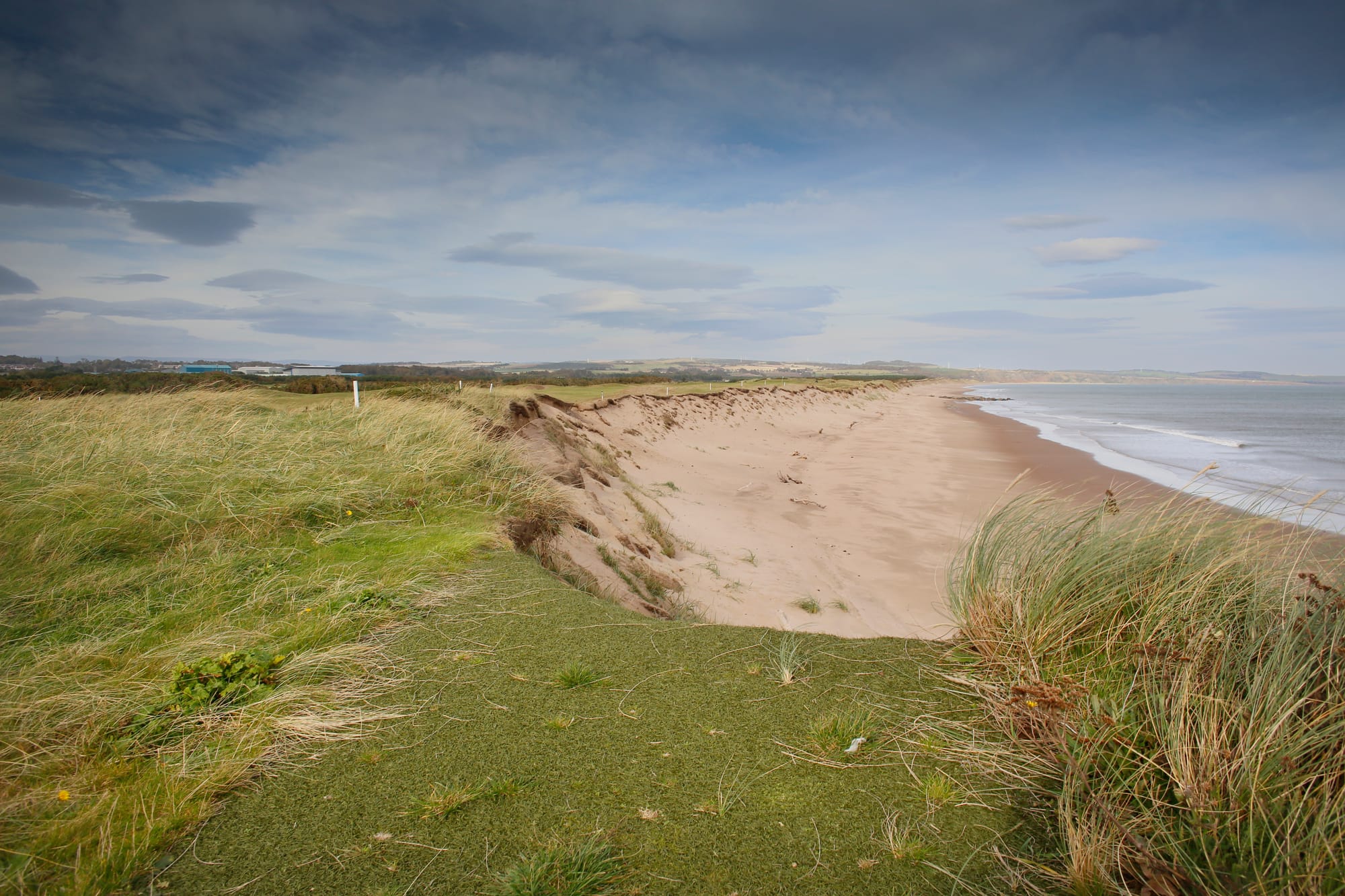
A keen golfer, the course Wood plays is being eaten away. We’re on the second hole with the retired oil worker. He points to a grass path from the tee that once led to the fairway but now disappears off the edge of the course to a sandy beach stretching northwards. From this angle, it’s a remarkable sight, a road to nowhere that offers a startling visualisation of the stark impact of climate change — a coastline carved away.
A grass path from the tee on the second hole at Montrose's 1562 golf course disappears due to coastal erosion. Image by Angela Catlin.
Montrose is one of more than 100 Scottish golf courses at risk from coastal erosion and The Ferret visited Angus as part of our Green Drive series that examines Scotland’s golf industry and its relationship to climate change and the environment. Our report follows warnings that 10,000 coastal properties in the UK could be lost to coastal erosion in coming decades.
Two fifths of Scotland's golf courses are coastal and with climate change accelerating there are fears that some are in danger of eventually disappearing into the sea. Links courses on the east coast are particularly under threat. Tees, fairways, greens and surrounding rough areas have all been damaged by storms and rising sea levels.
Fund journalism that serves the public.
The Ferret investigates what’s going on in Scotland, and who benefits. Reader support keeps our journalism independent.
World famous courses like Carnoustie, Royal Troon, Royal Dornoch and North Berwick are facing problems, as is the ‘home of golf’ – St Andrews Old Course – where a disappearing coastline is a stark reality. Montrose, home to the fifth oldest golf course in the world, dates back to 1562, Wood says. He explains it has two courses – Broomfield Course and the 1562 championship course – and covers an area of 250 hectares. Its grasslands, gorse and heather provide not only challenging conditions for golfers but habitats for the likes of kestrels, skylarks and oystercatchers. The landscape is coloured in spring with maiden pink and bluebells.
But the course is losing land. In 1994, its original sixth tee disappeared and in 2017 the third tee was moved away from the edge – but it’s now gone too. According to a project called Dynamic Coast in 2021, Montrose will lose 120 metres of coastline over the next 40 years – roughly three metres every 12 months, if nothing is done. “The sea has advanced 70 metres in the past 30 years,” says Wood, as we walk up the second fairway, adding that wild weather has caused havoc including Storm Babet, an intense cyclone that battered eastern Scotland in October 2023, bringing heavy rainfall. Montrose’s beach promenade suffered major damage during Storm Babet, he says. “I’ve never seen anything like it,” adds Wood. “We lost seven meters in two days.” Babet was followed by Storm Gerrit in December which brought gales of 86mph.
David Wood, of Montrose Community Council, at Montrose Golf Links where the coast has been eroded due to climate change. Image by Angela Catlin
Rising sea levels
According to the Met Office’s latest ‘State of the UK Climate’ report, UK sea levels have risen 19.5cm since 1901 – with 2022, 2023 and 2024 the three highest years on record for “annual mean sea level.” The last three years have been the UK's top five warmest recorded and in 2024 nine named storms hit Britain. The report also revealed that over the past 32 years – from 1993 to 2024 – the UK sea level has risen by 13.4 cm.
The threat to Scottish golf was brought into sharp focus in 2021 when Dynamic Coast published research warning that at least 109 courses were at risk, or would be, if nothing is done by 2025. Dynamic Coast is a project funded by the Scottish Government, the Centre of Expertise for Waters, NatureScot, and the St Andrews Links Trust. It’s managed by NatureScot’s Alister Rennie, who explains that tackling coastal erosion is a complex problem involving multiple parties and scenarios. “I support discussions at a national scale and we do science at a national scale”. If nothing is done, he says, “we’ve got £1.2bn worth of assets at risk by 2050.
Responsibility for the country as a whole lies with the Scottish Government, he says, but local authorities have legal obligations under the Coastal Protection Act of 1949. Landowners also have responsibilities so it needs to be a “tiered approach”, Rennie adds. Dynamic Coast also works with bodies like St Andrews Links Trust which manages seven golf courses at the ‘home of golf’ – including the Old Course. Golf has been at St Andrews for 600 years but coastal erosion poses a significant threat, endangering areas like West Sands beach, where the Oscar winning film Chariots of Fire was filmed, and the Jubilee Course's 8th hole. Solutions have included enlisting the help of a rare breed of Hebridean sheep “to support coastal biodiversity” while more than 28,500 tonnes of sand has been transported to rebuild lost dunes.
Rennie stresses there are different challenges around Scotland and it’s about finding “bespoke solutions” for individual golf courses. After Dynamic Coast’s work in 2021 the Scottish Government funded a coastal change adaptation fund worth £12m to encourage local authorities to think creatively about challenges and how they're going to adapt. The golf industry has also been proactive. In 2020, a report was commissioned by the R&A, the world golf body, to investigate the effects of climate change and its 'Golf Course 2030' project recommends golf courses produce a coastal management plan to mitigate coastal change. “There is no identical solution for each golf course and so it provides an overview of resources and practical guidance which can be applied by facilities related to their own situation,” a spokesperson for the R&A told The Ferret.
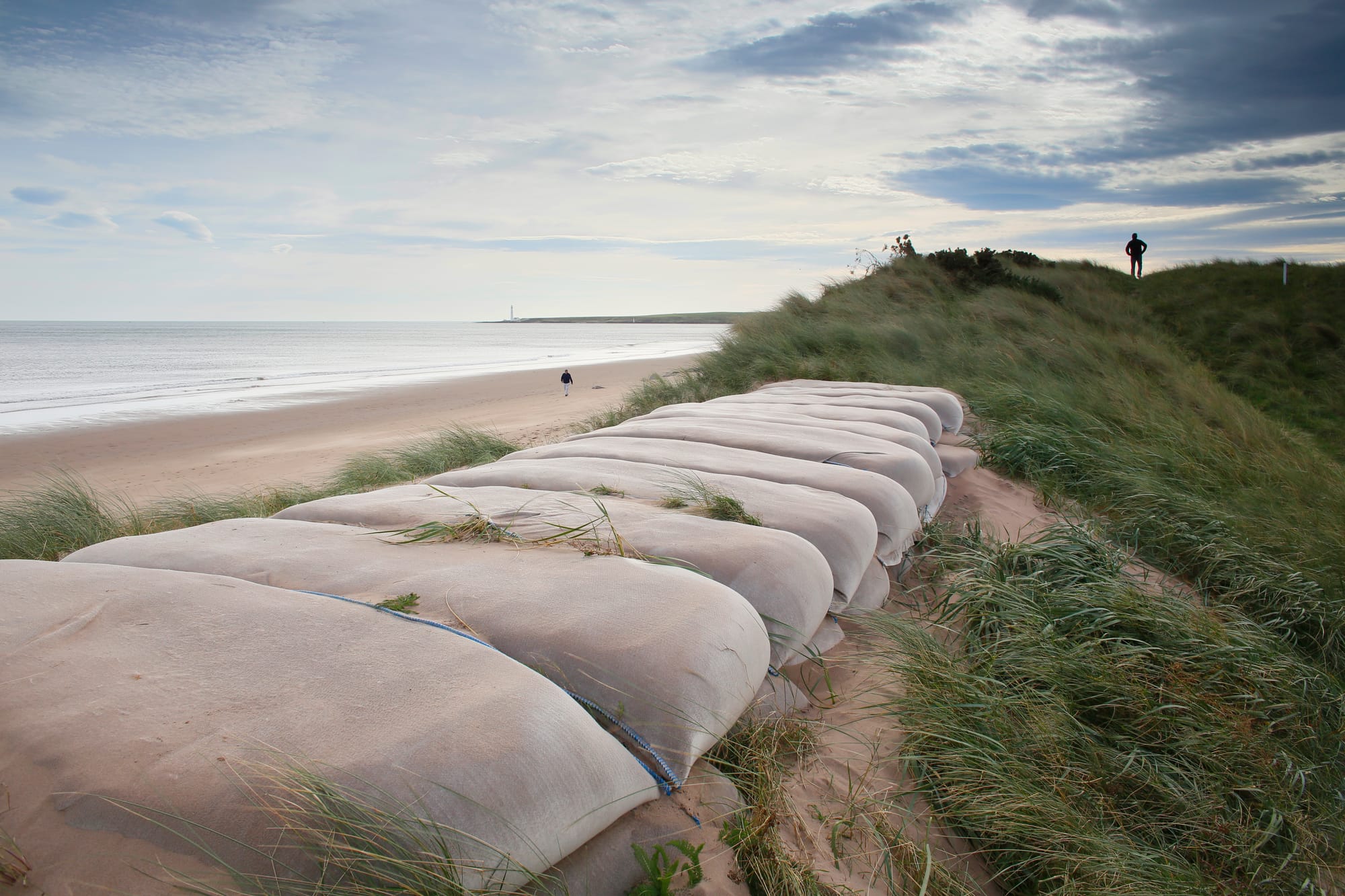
Specially engineered sandbags at Montrose beach as part of Angus Council's coastal defence project. Image by Angela Catlin.
Flooding, erosion and salt marshes
In Sutherland, the Royal Dornoch Golf Club has won an award tackling coastal erosion which has been threatening an area of its Struie Course. Golf has been played at Dornoch since at least 1616 when records show that Sir Robert Gordon of Sutherland, a privy councillor, claimed “ten poundis” in expenses for “golf clubs and golf balls” after tutoring a local earl.
Today the course is world renowned. It attracts thousands of golfers each year and was ranked number two in world golf two years ago by Golf Digest, a trade publication in the USA. “Legendary architect Donald Ross, a greenkeeper and our first professional, regarded his hometown links as ‘the most beautifully situated in the world’,” Royal Dornoch general manager Neil Hampton told The Ferret when we visited the town. He explained that the Struie Course, a sister to Royal Dornoch’s championship course, has been at risk from flooding and coastal erosion for years, with the tenth fairway threatened.
“We were actually losing bits of the coast,” says Hampton, recalling the situation when he started working here in 2010. “We're driving along thinking ‘we've lost a wee bit there’. The conversation was about maybe moving the fairway and that's when we started looking into what we could do to save it. If nothing was done we could have lost the whole fairway,” he said. The problem at Dornoch is not huge sea wave breakers battering the coastline, he says, rather a “really quick flow of water” at times. The first idea was to try recycled Christmas trees which had proven successful for erosion at the Royal Troon course in Ayrshire. The trees are buried in sand dunes to act as natural barriers. They trap sand, stabilise existing dunes, and protect against storm surges and rising sea levels.
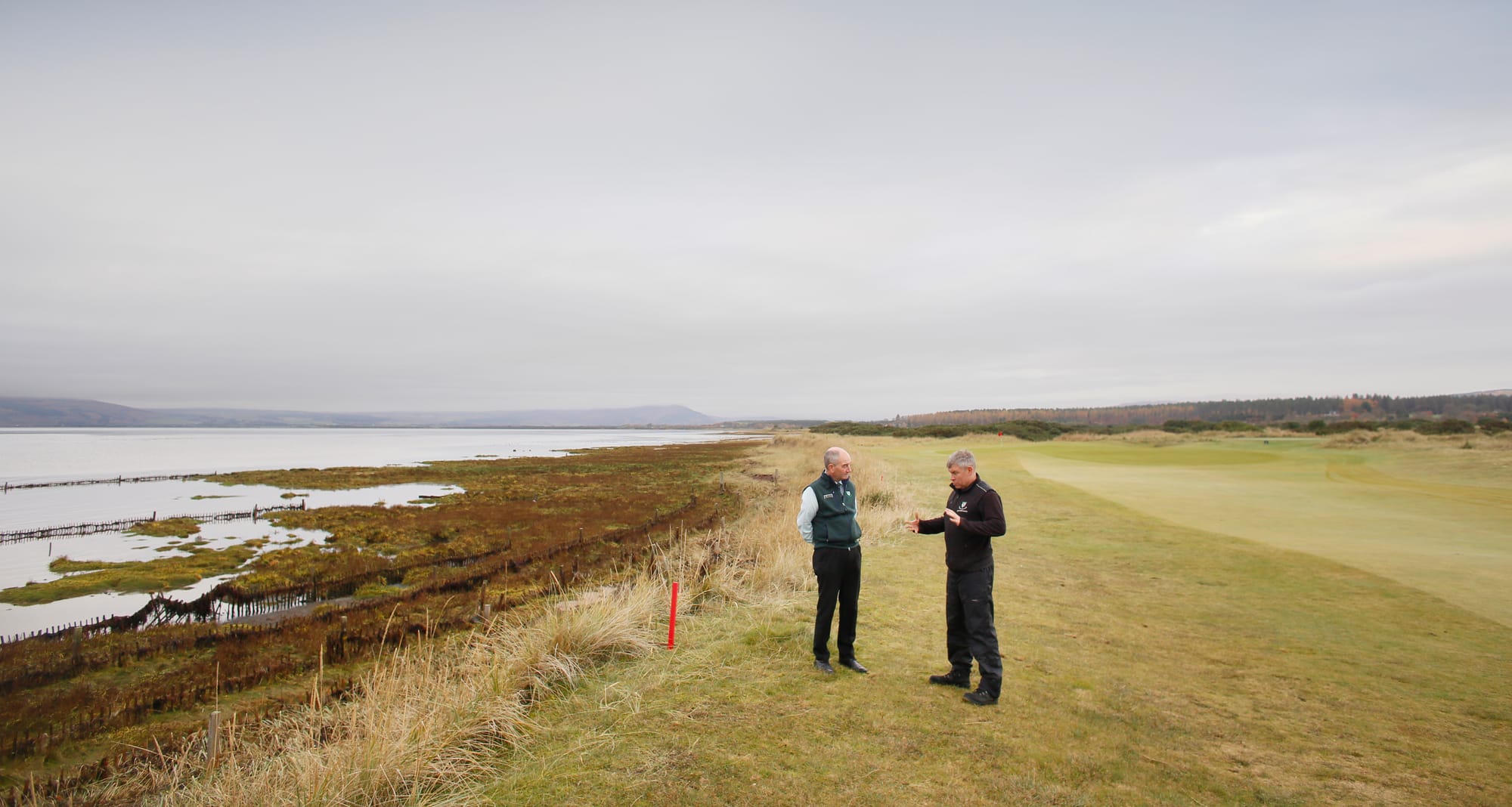
That was ineffective though because the sand at Dornoch is too “hard packed and doesn’t blow around”, Hampton says. The next idea was to try chestnut fencing as barriers, wooden fences that trap wind-blown sand and protect vegetation. This was successful. But the team then discovered that salt marsh had disappeared at the edge of the course. Salt marshes protect land from coastal erosion and flooding and are one of the best habitats for carbon storage as a nature-based solution in a rapidly changing climate. Royal Dornoch started working on a project called Green Shores with Dr Clare Maynard, a scientist at St Andrews University, which involved planting hundreds of greenhouse-grown native salt marsh plants in an attempt to restore natural defences, a solution which has helped restore salt marsh on the Eden Estuary and Tay Firth.
Neil Hampton (left) and Scott Aitchison of Royal Dornoch Golf Club on the 10th fairway of its Struie Course. Chestnut fencing and salt marsh, to the left, is tackling coastal erosion. Image by Angela Catlin.
“We realised that the salt marsh on the beach was breaking up – leaving a gap, and that’s where the erosion was happening. We had to break up the power of the sea,” Hampton said. "We planted salt marsh plants and that broke the energy of the waves. We saved that fairway.’
Back at Montrose, we walk down the second fairway with David Wood and onto the beach where massive sandbags have been placed strategically to prevent flooding from the North Sea. There is also a rock groyne on the beach, a barrier constructed with large rocks which catches sand as it naturally moves along the shoreline, helping to keep the beach in place and manage coastal erosion. It is part of Angus Council’s coastal defense project involving temporary flood defenses,” Wood says.
The latest assessment of Montrose Bay was published last year. It was commissioned by Angus Council and carried out by the University of Glasgow and Dynamic Coast. The report said erosion continues to affect many parts of the beach with “some of the fastest known rates of change on record” were measured during winter 2023/24 when up to 12 metres of dunes were lost over a few stormy days coinciding with spring tides. Angus Council says the rate of future erosion is now predicted to be higher than previously anticipated but there is evidence the rock groyne and “specially engineered sandbags” are having a beneficial effect.
Wood says local people are trying to help. “It's not just about protecting the golf course, it's about protecting our land and our beach.”
A rock groyne on Montrose beach, which is a barrier of large rocks which catches sand as it naturally moves along the shoreline, helping to keep the beach in place and manage coastal erosion. Image by Angela Catlin.
This story is part of Green drive: Golf and the environmental crisis – a series on golf and the environment funded by Journalismfund Europe – an independent, non-profit organisation in Brussels that supports cross-border investigative journalism.
Our investigations were carried out in partnership with the Spain-based journalist, Natalie Donback, and Italian journalists coordinated by the Fada Collective.
Billy is a founder and co-editor of The Ferret. He's reported internationally and from Scotland, and focuses on far right extremism, human rights, animal welfare, and the arms trade. Likes longform storytelling and photography.
Anas Sarwar's party accepted over £7,000 from Stonehaven, a lobbying firm which represents the owner of Scotland's last nuclear power station. Scottish Labour has sought to make nuclear power a battleground in the May election.
A Ferret investigation has found there was no registration to sell vapes at the Union Street premises in Glasgow where a major fire started - and we can reveal the name of the company behind the shop.
Huge volumes of sewage sludge have been used to fertilise Scottish farmland. Studies show it contains microplastics, forever chemicals and cancer-linked pollutants.