

Claim 'abortion to birth' is now legal in the UK is Mostly False
Changes to abortion law in England and Wales have been misrepresented on social media.
Changes to abortion law in England and Wales have been misrepresented on social media.
Climate change is causing rising sea levels and coastal erosion and 109 Scottish golf courses are at risk. We examined the issue as part of Green drive: Golf and the environmental crisis – a special Ferret series on golf and the environment.
The Ferret exposed the extreme views of Reform UK’s Scotland’s candidates before Nigel Farage promised to improve his party’s “poor” vetting processes, but many of them have been re-selected to fight the Holyrood election.

Scotland’s leading independent schools were worth £12.3m more in 2021 than they were the previous year, despite the impact of the Covid-19 pandemic.
The Ferret examined the accounts of 37 independent schools and found that 26 had increased their net total assets when compared to the previous year, despite claims from a body representing these schools that Covid-19 had cost the independent school sector £40m.
The net assets of five schools – Glasgow Academy, Edinburgh’s Fettes College and George Heriots School, Dollar Academy in Perthshire, and Robert Gordon’s College in Aberdeen, had all increased by more than £1m each. Net assets are the value of an organisation’s assets minus its liabilities.
The Ferret’s research excluded schools that had not yet published accounts for 2021, and schools part of larger groups that do not provide separate accounts for their Scottish operations.
“My challenge to the private schools and to Scottish policy makers is this, use these newly stored resources which The Ferret has pointed out to build educational bridges between the private and public sectors.”
Lindsay Paterson, professor of educational policy at the University of Edinburgh
The proportion of pupils receiving subsidised places at a fee paying school is a key measure used by the Scottish Charity Regulator to determine whether independent schools should retain their charitable status.
The five schools named above provided subsidised places to an estimated 476 pupils in the same year, less than 10 per cent of their combined roll. The number of pupils receiving 100 per cent discounts on fees is far smaller.
At Fettes school in Edinburgh, where the net asset value of the charity running it rose by £2.3m between 2020 and 2021, just 31 of its 791 pupils received bursaries to cover 100 per cent of the fees. A non-residential place at Fettes cost £32,760 per year.
Glasgow Academy – which offers bursary places from P7 to S6 – gave out 133 subsidised places to families with a joint income of under £65k. It accounts for 15 per cent of the school roll of those year groups. Of those just 26 were full bursaries.
This year a key tax-break for independent schools in Scotland was removed after a delay. MSPs were set to force private schools to start paying commercial rates from September 2020, as part of changes to property taxes brought in with the non-domestic rates (Scotland) Bill.
However, the rule change was delayed until April 2022 as part of measures introduced by the Scottish Government to help the country manage Covid-19.
“These are not just schools, and they certainly are not charities. They are profitable businesses which have no need for charitable status and it is absolutely right that we removed one of the tax breaks which came with that status.”
Ross Greer MSP, Scottish Greens’ Education Spokesperson
Independent schools in Scotland with charitable status will still benefit from other tax-breaks that state schools cannot access. For example, donations to charitable schools will still be eligible for Gift-Aid. This scheme allows charities to boost the value of most donations by 25 per cent, by claiming money back from the government.
The operating surpluses and capital gains that independent schools may generate are also exempt from income tax, capital gains tax or corporation tax.
Last summer several Scottish private schools – including Gordonstoun, George Heriots and Glasgow Academy – reported an increase in applications. They claimed this were driven by parental concern about the impact of lock-down restrictions, which saw schools close for months during the pandemic.
The growing resources of Scottish private schools contrast with a long-term decline in spending per pupil in state schools.
The Institute for Fiscal Studies estimated that taxpayer spending per pupil in Scotland remains higher than elsewhere in the UK, but still declined by seven per cent in real-terms between 2010 and 2015.
The latest Scottish budget shows that broad swathes of government spending are likely to be squeezed in coming years. Public sector spending on education and skills is set to fall to 95 per cent of current levels by 2026, despite rising inflation.
Meanwhile the poverty-related attainment gap remains wide and existing inequalities have been exacerbated by the Covid-19 pandemic, according to Audit Scotland.
The Scottish Greens’ education spokesperson, Ross Greer MSP, claimed that private schools “maintain and entrench inequality” and exist to “protect the power and privilege of the wealthiest people” in society.
He added: “These are not just schools, and they certainly are not charities. They are profitable businesses which have no need for charitable status and it is absolutely right that we removed one of the tax breaks which came with that status.”
Lindsay Paterson, professor of educational policy at the University of Edinburgh, said there were arguments in favour of private education, including the principle that parents should have the choice about how their child was educated.
“The wider public benefit of the private schools should be taken much more seriously by policy makers,” he added. “There needs to be more sharing of resources, sharing of teachers, and inclusion of students in networks that extend to both the public-sector and the independent schools.”
“My challenge to the private schools and to Scottish policy makers is this,” Paterson continued. “Use these newly stored resources which The Ferret has pointed out to build educational bridges between the private and public sectors.
“Encourage this by means of matching funding from public authorities (local and national government, and universities). In short, take the private sector at their word as beacons of excellence and induce them to share that excellence with the whole of Scottish education.”
Steven Dignall, director of external relations for Glasgow Academy, said: “The reason for the increase in net assets is investment gains that were made in this time period. We offer means-tested bursaries which are worth 6.2 per cent of our income.”
Under Charity Commission laws the school must spend at least five per cent of its income on charitable means. “We aim to go above and beyond,” added Dignall. “We would like to offer more bursaries but this is restricted by places, and families who exceed the income threshold cannot apply.”
The school was “very much part of Glasgow”, he added, offering subjects such as accountancy to “cluster” state schools in the area where it was not taught and making an online platform – thinkfour – targeted at Higher pupils available for free.
John Edward, director of the Scottish Council of Independent Schools (SCIS), said independent schools are not profitable businesses, by law, and “they have zero desire to be”. He added: “The assets that independent schools hold are almost entirely the buildings in which young people are educated. These are not assets that can be realised in any way while operating as a registered charity.
“Any increase in their value on paper has no bearing on a school’s operations. Many are protected and listed buildings, most built many years ago for the purposes they are still used today – namely education.
“Most fee income is spent directly on teaching and non-teaching staff pay and pensions, not to mention unrestricted utilities bills or building upkeep. One school mentioned has spent over £3m on building upkeep alone in recent years.”
“During the pandemic we were able to pivot quickly to ensure our students benefited from ongoing engagement and continued structured learning. As a result, we saw an upturn in applications from families wishing their children to join our school.”
A spokesperson for Fettes College
Edward continued: “Very few schools, if any, have turned even a surplus over the years of the pandemic and, as not-for-profit registered bodies, they are legally unable to make a profit. The challenge over those years has been to survive, and then to ensure the young people in their care, from across the world, are safe, happy, engaged and informed. Their ability to do so under extreme conditions speaks for itself.”
A spokesperson for Fettes College said: “There are two main reasons for our growth in net worth. We had an increase of pupil numbers year on year due to demand and an increase in the percentage of boarders.
“During the pandemic we were able to pivot quickly to ensure our students benefited from ongoing engagement and continued structured learning. As a result, we saw an upturn in applications from families wishing their children to join our school.”
They added: “Fettes is committed to broadening access to the school by offering means-tested financial support towards the payment of school fees – known as a bursary. Our bursaries can cover up to 110 per cent of fees payable, depending on the financial circumstances of applicants.”
A Scottish Government spokesperson said: “The Scottish Government has removed eligibility for charitable rates relief from mainstream independent schools as per the recommendation in the independent Barclay Review of non-domestic rates.”
George Heriots School, Dollar Academy, and Robert Gordon’s College were asked to comment.
Recent research looking at UK independent private schools found that less than seven per cent of pupils attend private schools in the UK, while in 2020, more than 31 per cent of students at Oxford University were privately educated.
This educational disparity, the authors argued, “is effectively subsidised by all UK taxpayers through a broad range of tax exemptions available to private schools with charitable status.”
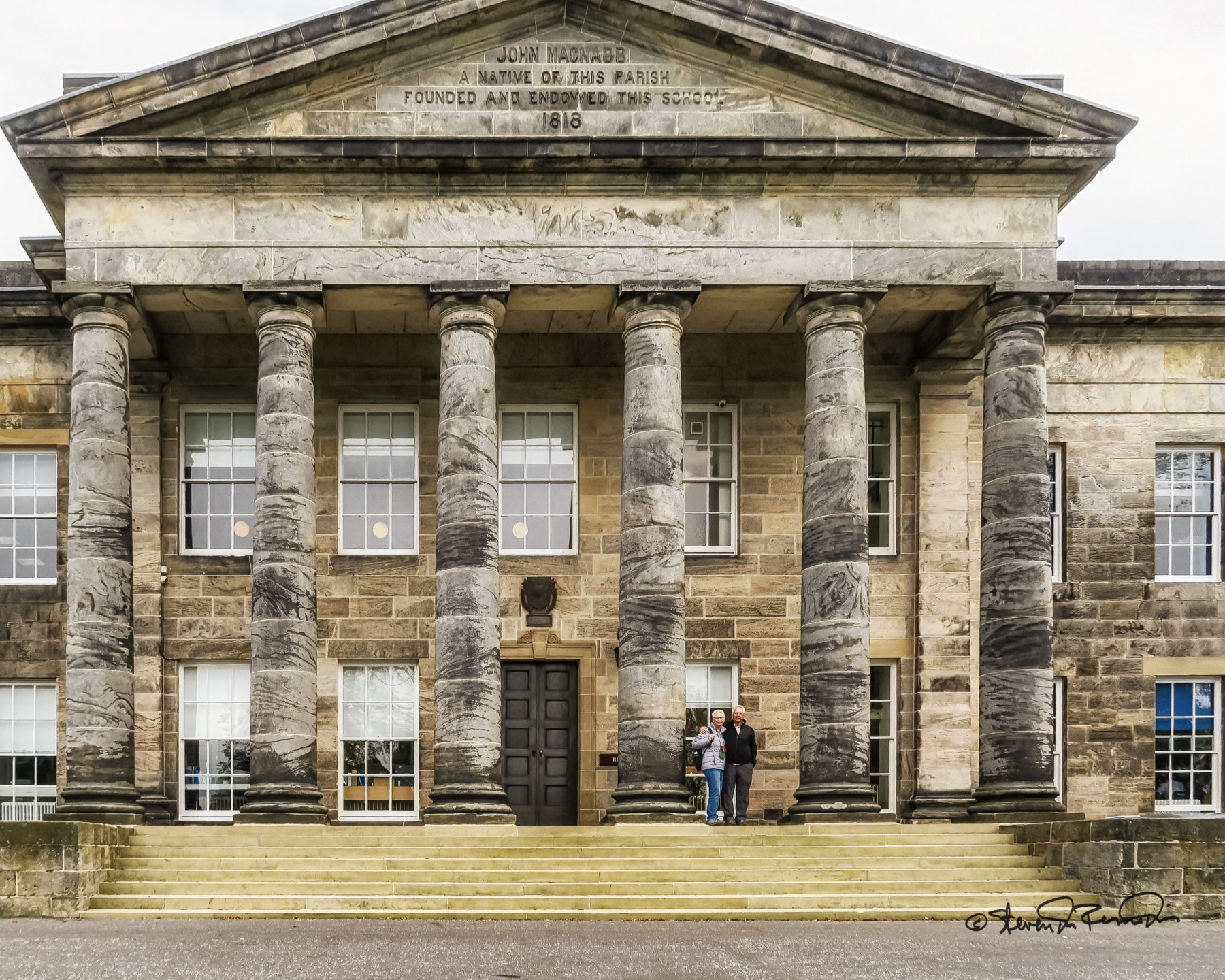
Image credit: Fettes College | CC BY 2.0 | Ben Heathwood | https://flic.kr/p/s4KVjp.
This story was co-published with the Sunday National.


The Ferret exposed the extreme views of Reform UK’s Scotland’s candidates before Nigel Farage promised to improve his party’s “poor” vetting processes, but many of them have been re-selected to fight the Holyrood election.

Online claims questioned Scottish Labour's house building in government between 1999 and 2007.

Sir Peter Mathieson appears to have confirmed he is being paid for a board role at a university spin-off at the same time as many staff face uncertainty about their futures.


The first minister has been criticised online for staying with Mandelson on a trip to the US last year. We looked at the truth behind the claims.


