The Scottish Government has continued to back Ming Yang’s proposed investment at Ardersier despite national security concerns. It’s now being accused of a “staggering” failure of due diligence on the firm.
This summer we revealed that convicted loyalists from Belfast travelled to Glasgow for a far right protest. Further digging has unearthed a rapidly expanding anti-immigration network between Scotland and Northern Ireland.
Authorities tightened the rules around this Scottish business scheme after years of exploitation for financial crime. Moscow entities – and a man accused of facilitating child sex abuse – are still selling it to clients seeking “financial privacy”.
A spaceport plans to dump tonnes of rocket junk into the sea north of Shetland, posing a risk to tourism and fishing
Tourism and fishing associations in Shetland have voiced alarm and concern about the plans, while campaigners condemn space companies as “litter louts".
Scotland’s first spaceport on Shetland plans to use the sea as a “dustbin” to dump tonnes of debris from rockets, The Ferret can reveal, prompting claims it could endanger tourism and fishing.
SaxaVord Spaceport on the island of Unst is applying for a licence to start dropping large, disused rocket components into the sea north of Shetland over the next 12 months. The application reveals that there is a “significant risk” that the debris could hit tourist and fishing boats, posing a threat to life.
The Shetland tourism industry however, flatly rejects the spaceport’s plans, and warns that sea dumping could be “devastating” for some island businesses.
A report by the Germany company Rocket Factory Augsburg, which is planning the first launch from SaxaVord later this year, makes clear that discarded rocket parts will not be recovered from the sea.
They will be left to sink to the seabed where, it argues, they could become “artificial reefs” and benefit marine wildlife. The firm also claims there will be no “justified demand from the public” to remove them.
But this has prompted “serious concerns” from the Shetland fishing industry, which says that dumped rocket sections could endanger crews and damage fishing gear. It is demanding that debris is recovered, and fishing boats are compensated for any problems.
Owned by readers. Built for accountability.
The Ferret is member-owned journalism. That means we can follow leads that matter even when they’re uncomfortable for the powerful.
Environmental campaigners, who are about to publish a detailed report on the environmental impact of the international space industry, say that branding dumped rockets as wildlife-friendly reefs is a bid to “gaslight” people. They condemn billionaire-owned space companies as “litter louts” and claim they do not want to clean up the mess they make.
SaxaVord’s application for a sea dumping licence is currently being considered by the Scottish Government. Correspondence released to The Ferret under freedom of information law discloses that the spaceport has been privately lobbying ministers, including the first minister, John Swinney, to speed up the application.
The industry has also been pressing ministers to keep details of the application secret – and to make SaxaVord a “freeport” so it could benefit from tax breaks and less red tape.
Neither SaxaVord nor Rocket Factory Augsburg have responded to repeated requests to comment. But their websites stress their commitments to protecting the environment and safeguarding “our precious planet”.
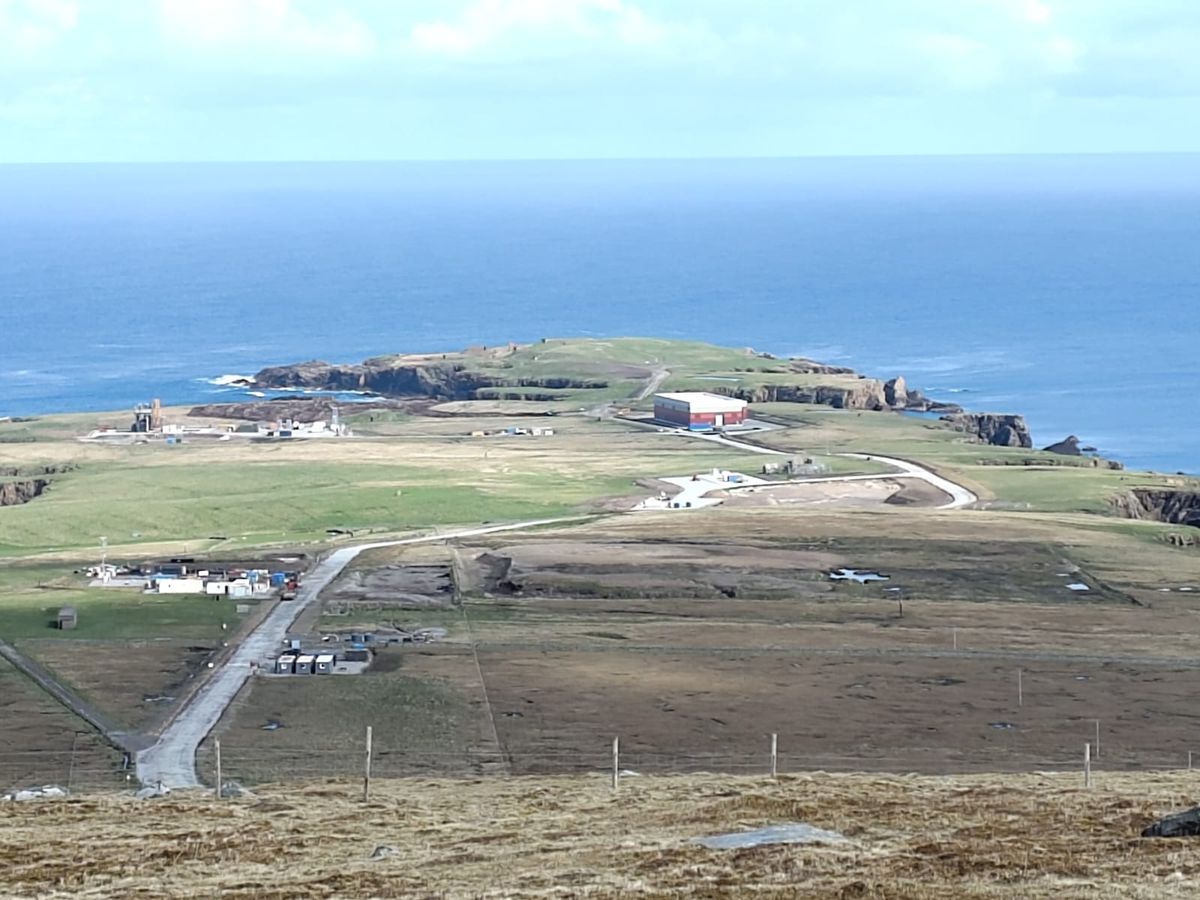
SaxaVord Spaceport is being built on the Lamba Ness peninsula on Unst, the northernmost inhabited island in the Shetland archipelago. The company is majority-owned by the Danish billionaire businessman, Anders Holch Povlsen, who is Scotland’s biggest private landowner.
According to a briefing for a visit to SaxaVord by Swinney, in February 2026, the spaceport was given £10m by the UK Government and £473,000 by the Scottish Government’s Highlands and Islands Enterprise. The company made a loss of £5.4m in 2024.
The first launch by Rocket Factory Augsburg has been repeatedly postponed following the explosion of a test rocket on its launch pad at SaxaVord in August 2024. It is currently expected in the next few months.
SaxaVord applied to the Scottish Government in March for a licence to dispose of debris from the launch in the sea between 1 July 2026 and 30 June 2027. The application says that the rocket’s nose cone and first stage will be jettisoned into a “designated hazard area” in the sea north of Shetland.
The nose cone is eight metres long and weighs 250 kilograms, while the first stage rocket is 21 metres long and weighs 4.5 tonnes. According to an email to the Scottish Government, a second German company, HyImpulse, is also planning to launch a rocket from SaxaVord in September 2026.
A “navigational risk assessment” by expert consultants, NLA International, for the licence application says that SaxaVord has been negotiating with a total of five companies to make nine launches in the next few years. Altogether, the rockets weigh over 550 tonnes, and sections of all of them are due to be dumped in the sea.
“I was horrified to see that there could be a risk to tourists.” — Amanda Hawick, Shetland Tourism Association
The assessment, dated September 2025, concludes that the “highest risk” from the launches is undetected recreational and fishing boats being “struck by rocket debris”. This is “significant”, it says, and poses a “risk to life”.
The risk is rated as “tolerable”, but only if six measures are taken by SaxaVord to alert mariners to the dangers up to three months in advance, and to intensively monitor shipping.
The assessment highlights two other risks that are only “tolerable with modifications”. One is “a rocket fails or is terminated soon after launch and debris lands on a vessel at sea.” The other is from a rocket failing before it reaches orbit dumping debris that stays afloat and is hit by a boat.
The assessment says that the risk of rocket debris damaging fishing gear is “tolerable with additional controls”. Six other risks, including collisions with offshore oil or wind installations or damaging wildlife areas, are rated as “tolerable with monitoring”.
SaxaVord plans a “launch exclusion zone” stretching more than 17 miles north of Unst in which shipping would be banned. According to the risk assessment, the area was used by 332 boats of all kinds in 2024.
But the total area potentially impacted by initial launches is much bigger. It’s a huge cone covering over 400,000 square miles of the seas between Shetland, Greenland, Iceland, and Norway.
“Fishermen cannot be expected to work around hazards they are not allowed to see.” — Sheila Keith, Shetland Fishermen’s Association
According to the assessment, over 3,000 cargo, fishing and other boats used the area in 2024. The area is fished all the year round by hundreds of vessels, primarily for herring and mackerel, with Shetland having up to 300 commercial boats.
Fishing peaks every August as Norwegian and Russian fleets follow shoals of herring and mackerel. This “may increase the risk to exceed beyond what is tolerable to undertake launch operations without appropriate control measures,” the assessment warns.
The SaxaVord assessment also highlights that future launches could impact a second large expanse of sea, further away on the other side of Greenland. This includes the Beaufort Sea and part of the Arctic Ocean off the north coasts of Canada and Alaska.
Another report examining the “best practicable environmental options” for the sea dumping licence application was prepared by Rocket Factory Augsburg in February 2026. Recovery of the dumped nose cone and rocket is not planned because it is “an expensive and hazardous operation”, the report says.
The rocket parts, which are mainly made out of steel, are designed to sink to the bottom of the sea. There they “may start an artificial reef and serve as a habitat for marine life,” the report claims.
“It is therefore very unlikely that there will be a justified demand from the public to remove the debris once the environmental benefits of such artificial reefs have been communicated.”
The Shetland Tourism Association greeted the space companies’ dumping plans with an “absolute no”, demanding they be halted. “I was horrified to see that there could be a risk to tourists,” the association’s chair, Amanda Hawick, told The Ferret.
“No-one should be at any risk at all. It’s absolutely shocking what they are planning.”
The impact could be “devastating” for some tourist businesses, she warned. She accused SaxaVord of “trying to railroad this through” without proper consultations.
“Debris must not be left on the seabed where it can damage gear or endanger crews, and any proposal to deposit rocket parts in productive fishing waters requires robust mitigation and compensation measures,” said the association’s executive officer, Sheila Keith.
She complained about a “lack of detail” on the proposed exclusion zones. “Fishermen cannot be expected to work around hazards they are not allowed to see,” she argued. “They need full transparency about any activity that affects their safety or access to traditional grounds.”
The campaign group, SpaceWatch UK, pointed out that the public and marine industries were working hard to avoid dumping rubbish at sea. It accused the space industry of wanting a “get-out-of-jail-free card” to “ditch launch junk in the ocean”.
"Launch companies then have the cheek to try to gaslight us by saying that dumping space junk in the sea forms artificial reefs which are good for the environment, even though there is absolutely no evidence to support this claim,” said the group’s Peter Burt.
He is the author of a report entitled “Waste Of Space: The Environmental Cost of Human Activities in Space”, which is due to be launched at an online meeting on 1 July. "The Scottish Government should not be acting as lackeys for super-rich litter-louts who think they use the ocean as a dustbin,” he told The Ferret.
The Marine Conservation Society warned the sea must not be used as a “dumping ground”, and dismissed suggested artificial reefs as unproven. “As proposed this is simply pollution,” said the society’s Calum Duncan.
Emails released to The Ferret under freedom of information law show that SaxaVord has repeatedly lobbied Scottish ministers on the licence application. In December 2025 two spaceport executives raised the issue when they met the then-business minister, Richard Lochhead, who as a result pressed government officials to explain the process.
An email from one of Lochhead’s officials in January 2026 said that SaxaVord had been “at times quite vocal” on the licence application. It was highlighted in the official briefing for first minister Swinney, prior to his visit to SaxaVord to sign the launch rocket on 23 February, and was the subject of other emails in March and April.
SaxaVord and Rocket Factory Augsburg have also been pressing the Scottish Government to keep sections of their sea dumping licence application secret. In its application form, SaxaVord asked ministers not to publish some of the documents because they contained “commercially sensitive information”.
At an online meeting with government officials on 31 March, SaxaVord and Rocket Factory Augsburg pressed for the “impact containment contours” of launch hazard areas to be excluded from published information. Officials stressed that as much information as possible should be made available, and could not understand why the contours would be “commercially sensitive”.
According to the minutes of the meeting, one of the space companies’ representatives, whose name has been redacted, said that “giving mariners too much information can be counterproductive as it could illustrate certain areas as being safer than others, and therefore acceptable to enter.”
“The sea must not be used as a dumping ground.” — Calum Duncan, Marine Conservation Society
SaxaVord also urged Lochhead and Swinney to make the spaceport a “freeport” with tax breaks and less red tape. SaxaVord’s deputy chief executive, Deborah Strang, wrote to Swinney on 2 March 2026, arguing this would be a way to help provide “significant government support and funding”.
The Scottish Government declined to comment on a live marine licensing application. “All relevant documentation has been submitted and consultation has taken place and a determination is ongoing,” said a spokesperson.
“When deciding whether to grant a marine licence, Scottish ministers must consider the need to protect the environment and human health, and to avoid interfering with other legitimate uses of the sea. They take the management of risks from licensable activities very seriously.”
SaxaVord and Rocket Factory Augsburg did not respond to requests to comment. SaxaVord’s Facebook page confirms that a marine licence application has been submitted, but warns that “as with any first-ever launch, there are uncertainties, and the schedule may evolve.”
SaxaVord’s website highlights its “founding commitment” to “minimise our environmental impact on earth and in space”. It adds: “We will work with launch operators to track returning components and record jettisoned material entering the marine environment.”
Rocket Factory Augsburg’s website says it is “committed to making a more sustainable world”. Its goal is to “democratise access to space” in order to better understand and protect “our precious planet”.
Independent journalism isn’t free, but it is essential.
We investigate power, money, and decisions made in public view. Reader support protects our independence and gives us time to do work that others won’t.
Rob has more than 40 years’ experience specialising in reporting on environmental issues. He has co-authored three books about nuclear power, produced radio and television programmes. He likes muckraking.
The Scottish Government has continued to back Ming Yang’s proposed investment at Ardersier despite national security concerns. It’s now being accused of a “staggering” failure of due diligence on the firm.
The Scottish Government has been supportive of controversial green data centres and is liaising with the industry. But critics argue there are environmental considerations and companies must not be allowed to “write the rules”.
Covert filming of farmed trout apparently suffering at an abattoir last year led to a firm being formally warned. New footage has prompted a fresh complaint.