

Hundreds of monkeys imported thousands of miles to Scotland for experiments
Macaques are a listed endangered species known for their intelligence. Large numbers have been shipped more than 6,000 miles to Scotland for experiments.
Macaques are a listed endangered species known for their intelligence. Large numbers have been shipped more than 6,000 miles to Scotland for experiments.

A new report claims Asos, part owned by Scotland’s richest man, is still harming the environment and not adequately supporting its workers. Asos says it is committed to addressing concerns about the fashion industry.

The UK Government will soon force many company owners to prove their identities. We don’t know when the people behind much-abused Scottish business schemes will face the same measures.

Macaques are a listed endangered species known for their intelligence. Large numbers have been shipped more than 6,000 miles to Scotland for experiments.

Join as a Ferret member to support our animal welfare work
Nearly 500 monkeys have been transported more than 6000 miles to Scotland from Mauritius to be used in animal experiments since the start of 2025, The Ferret can reveal.
The monkeys are used in tests at a research site in Tranent run by a company called Charles River Laboratories that buys, sells and experiments on animals.
The US multinational – which specialises in gene and cell therapy, medical devices, and biotechnology – conducts research on dogs, monkeys, rats and mice to make medicines, fertilisers and weedkillers.
But animal welfare campaigners have condemned its animal testing as “inhumane and unnecessary” and argued that non-animal methods could be used in research instead.
Charles River did not respond to our requests for a comment. Its website says that research using animals has contributed to treatments for cancer, diabetes, Aids, and the development of life-saving drugs, adding that the welfare of animals used in its tests is of “utmost importance”.
A freedom of information request to the UK Government’s Animal Plant Health Agency revealed that between 1 January 2025 and 29 September this year, 2,600 monkeys, mostly cynomolgus macacques, were imported to the UK for animal testing. At least 496 were transported to Scotland, according to animal welfare group, East Lothian Uncaged, which tracks imports.
The long-tailed macaques, known for their intelligence, were brought to the UK from France, Spain, as well as from Mauritius and Vietnam, which are each more than 6,000 miles away. They are listed as endangered by the International Union for Conservation of Nature.
 Billy Briggs
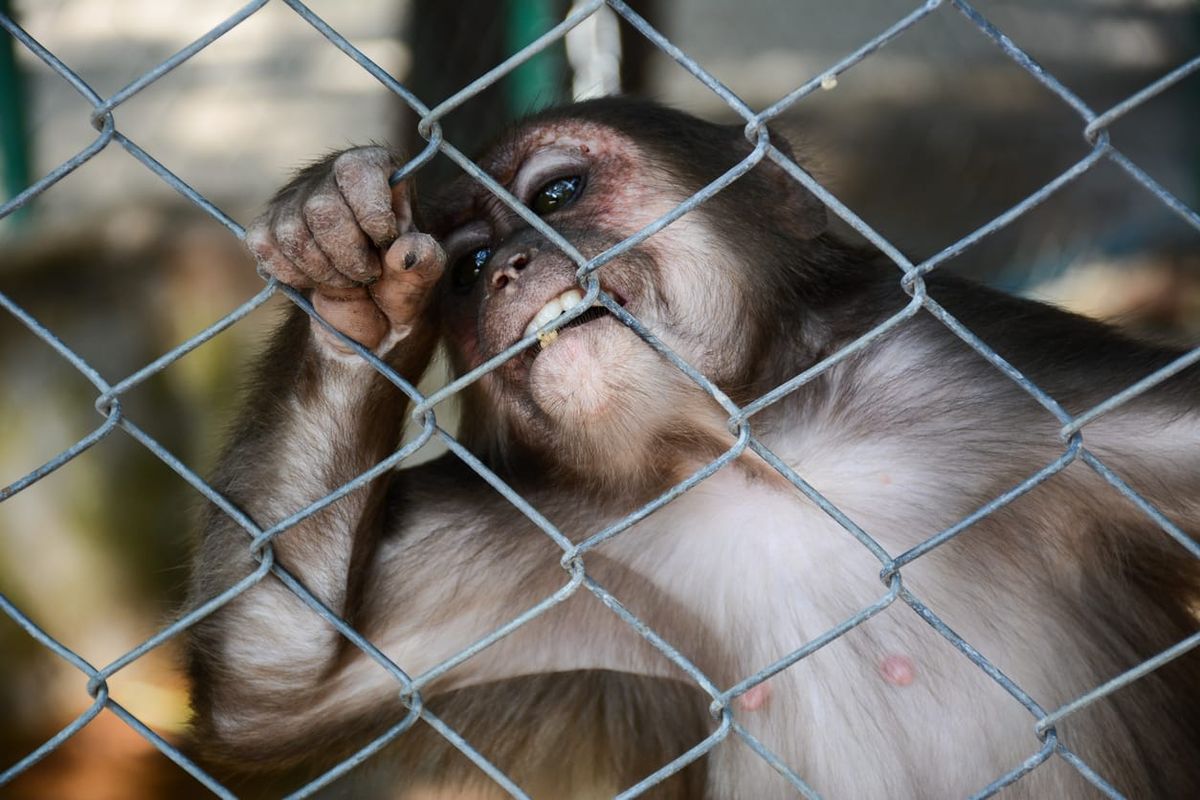
The monkeys are used in experiments at three research sites in the UK. Two are located down south in Harrowgate and Huntingdon while the Tranent site in East Lothian is operated by Charles River, which owns 90 per cent of a monkey breeding firm in Mauritius. In January Charles River bought a Cambodia-based monkey supplier for around £380m.
East Lothian Uncaged said it has filmed four vans with monkeys arriving at Charles River in Tranent since 28 May this year. Its activists work with other campaigners across the world to track planes arriving in the UK with imported monkeys.
The flights land at Manchester Airport and the animals are taken in vans to Harrowgate, Huntingdon and Tranent, said the activists, who claimed the monkeys are quarantined for three months on arrival before being subjected to testing for up to 120 days. They must be killed or returned to their country of origing after research projects end, according to the Animal Plant Health Agency.
Jessica Millburn, of East Lothian Uncaged, claimed monkeys endure “awful transport conditions” on planes and called for devolved legislation so that the welfare of animals in laboratories is covered by Holyrood and not Westminster, as it currently stands.
“It would seem crazy to the majority of a modern, compassionate society that an endangered species of monkey is flown half way around the world to suffer tremendously in contract testing laboratories such as Charles River,” she told The Ferret.
“If multi-billion-dollar companies like Charles River really had any faith in research, they'd have been pioneering non-animal methods years ago and advancing like many other industries across the globe have over the years. Instead they are stuck in the archaic past by still importing and testing on monkeys.”
"It is repugnant that any animal, let alone a species which is endangered in their native habitat, should be transported thousands of miles, for many terrifying hours, to suffer and die in laboratories here in the UK.” – Jessamy Korotoga, Animal Aid
Jessamy Korotoga, Animal Aid’s head of science, said: "It is repugnant that any animal, let alone a species which is endangered in their native habitat, should be transported thousands of miles, for many terrifying hours, to suffer and die in laboratories here in the UK.”
She added: “Their suffering would be morally unacceptable even if the experiments were scientifically robust, but they are not - data from animal experiments cannot be reliably translated to humans. Animal experiments fail humans as well as the intelligent, sentient animals who are victims of this macabre and horrifying global trade.”
Charles River’s policy on animal welfare – as detailed on its website – says that the firm “prioritises the humane care and wellbeing of research animals” and that employees receive mandatory animal welfare training.
“Charles River is committed to the three Rs (replacement, reduction, refinement) and will continuously explore and evaluate methods to minimise animal use, using non-animal testing methods, refining study designs, and improving animal care technique,” the policy states.
The Animal Plant Health Agency said in its freedom of information (FoI) response that all primates imported into the UK must be licensed and that veterinary health certificates are required to confirm the animals are “clinically healthy and the origin premises are not affected by infectious diseases”.
“It would seem crazy to the majority of a modern, compassionate society that an endangered species of monkey is flown half way around the world to suffer tremendously.” – Jessica Millburn, East Lothian Uncaged
The FoI reply added: “It is the responsibility of the vet in the country of origin to decide if the inspected animal is fit to travel. When animals are transported, their transportation must comply fully with legal requirements aimed at protecting their welfare.”
Once “activities relating to the scientific purposes have been carried out” on monkeys, it continued, “they and any products derived from them, with the exception of any portions used for the scientific purposes, must be disposed of or re-dispatched to the third country of origin”.
Last week we revealed that more than one million tests have been conducted on animals in Scotland since 2021, including experiments on dogs and monkeys, and the breeding of genetically altered creatures.
Research by animal welfare charity OneKind – shared with The Ferret – found that Glasgow and Edinburgh are among the top ten UK universities for the highest use of animals in research.
Be part of something bigger
Supporting The Ferret is not just about access. It’s a way to back journalism that’s accountable, impactful, and independent.

A new report claims Asos, part owned by Scotland’s richest man, is still harming the environment and not adequately supporting its workers. Asos says it is committed to addressing concerns about the fashion industry.

The UK Government will soon force many company owners to prove their identities. We don’t know when the people behind much-abused Scottish business schemes will face the same measures.

The founder of a Canadian "extremist, militia-like organisation” visited far right allies in Scotland. Critics question why a “dangerous individual" was allowed to enter the country.

Observations by campaigners suggest that three of the UK’s nuclear-armed submarines are currently at sea. This is the first time this has happened since 2022, and it’s caused concerns.
