

UK ‘escalating nuclear tensions’ with Trident submarines
Observations by campaigners suggest that three of the UK’s nuclear-armed submarines are currently at sea. This is the first time this has happened since 2022, and it’s caused concerns.
Observations by campaigners suggest that three of the UK’s nuclear-armed submarines are currently at sea. This is the first time this has happened since 2022, and it’s caused concerns.

As staff at Scotland’s largest university continue strikes over sweeping cuts, their boss still won’t say what his second job pays on top of his £425,000 salary.

Scientists argue that research using animals is vital for the treatment and cure of human diseases like cancers. But experimenting on dogs and monkeys is controversial and critics say alternative methods should be used.

Observations by campaigners suggest that three of the UK’s nuclear-armed submarines are currently at sea. This is the first time this has happened since 2022, and it’s caused concerns.

Helping you make sense of what really matters
From fact checks to investigations and explainers, The Ferret helps cut through noise with journalism that is careful, sourced, and worth your time.
The UK government has been accused of acting “provocatively” by putting three Trident nuclear submarines to sea at once, with campaigners warning that ministers are “stoking up a crisis”.
Nukewatch UK, which monitors nuclear weapons, told The Ferret on 15 October that three of the UK’s four Vanguard-class submarines had set sail from their bases on the Clyde.
The submarines are usually armed with Trident nuclear missiles, and it is rare for three of them to be at sea at once.
The Ministry of Defence (MoD) has made no official comment on the submarine movements. But on 27 October, days after The Ferret started asking the MoD questions, naval sources told The Times, and The Sun that three Vanguard submarines were at sea.
Campaigners are concerned that the deployments could “send the wrong signal” to Russia, and escalate “nuclear tensions”. The consequences of a misunderstanding could be “grave”, they warn.
The MoD stresses that the submarines are a “nuclear deterrent” and a “cornerstone” of national security protecting the UK and Nato allies “every moment of every day.”
UK government policy is to have one Vanguard submarine on patrol all the time, known as the “continuous at sea deterrent”. The other three are usually berthed at Faslane and Coulport, near Helensburgh, or in Devonport near Plymouth undergoing maintenance.
 Rob Edwards
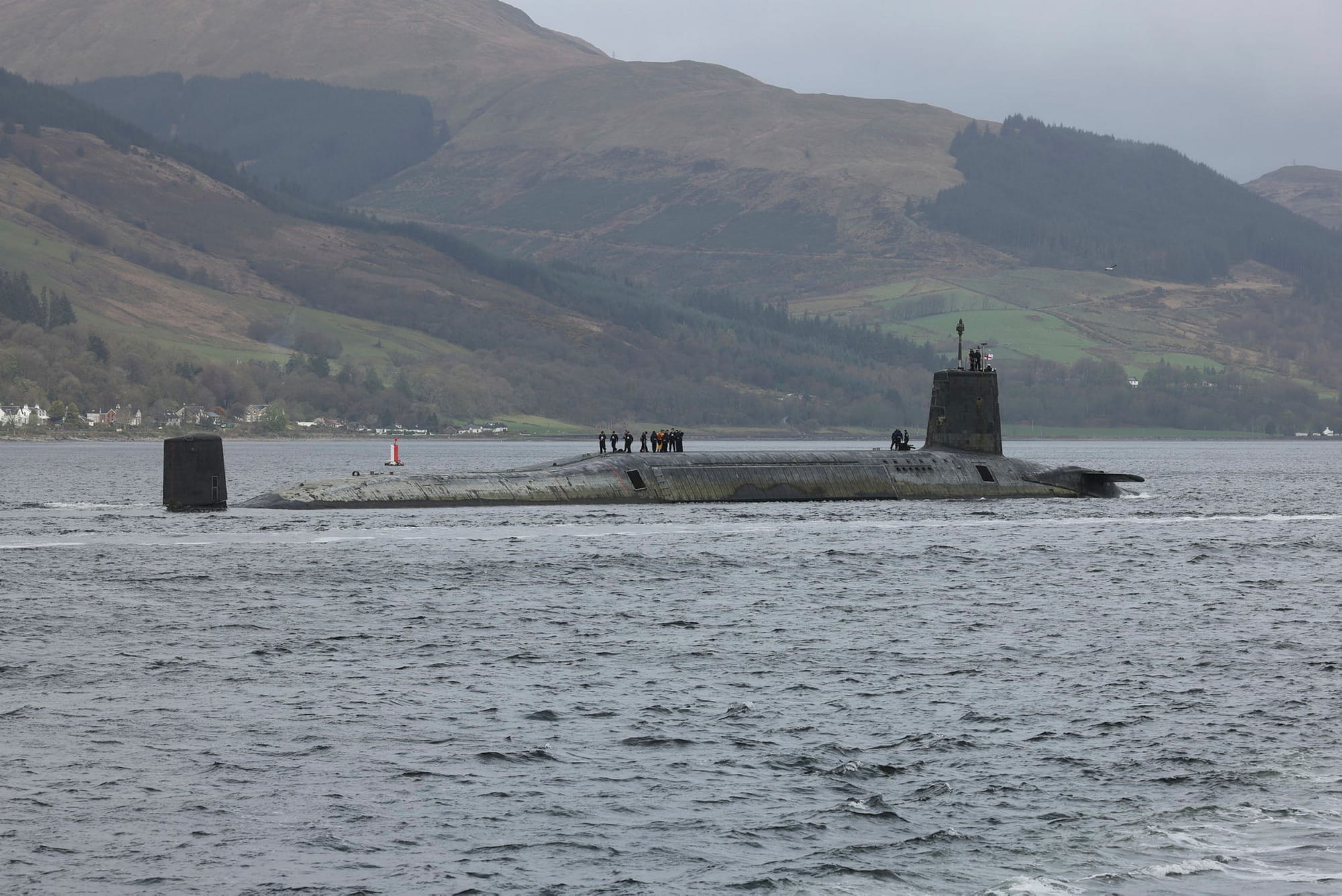
According to Nukewatch, the last time three Vanguard submarines were known to have been at sea together was for two days, and then 12 days, in October and November 2022. On 6 November 2022 The Sun reported that a submarine on patrol, HMS Victorious, had to return to Faslane after an electrical fire on board.
In June 2023 Victorious arrived at Devonport for an extensive overhaul. According to Nukewatch’s latest briefing, the other three – HMS Vanguard, HMS Vigilant and HMS Vengeance - are now all out at sea.
One was seen leaving Faslane on 12 April 2026. It is believed to have been on long-term patrol since then and has not been observed returning.
The length of patrols by the submarines has more than doubled in recent years, from two or three months to over six months. HMS Vanguard was welcomed back to Faslane by the then prime minister, Keir Starmer, on 18 April, having been at sea for 205 days – more than six and a half months, reportedly the longest on record.
Two submarines were seen going out and back in the Clyde over several days in September. Nukewatch then reported that they both sailed to sea within two days, one leaving the Coulport nuclear bomb depot on 12 October and the other leaving the Faslane naval base on 14 October.
One of the submarines that left in October could be preparing to replace the one that’s been on patrol since April. If that’s the case, the latter should return to Faslane in the next few weeks.
According to Nukewatch, the most likely explanation for the third submarine being at sea is that it is taking part in an exercise. The US launched its annual “nuclear readiness” exercise, Global Thunder, on 22 October.
The Royal Navy told The Ferret that it was planning to take part in the exercise with F-35 fighter jets from the aircraft carrier, HMS Prince of Wales. It declined to say whether or not Vanguard submarines would be involved.
On 26 October, an MoD social media post confirmed that British F-35s had flown alongside a US B-52 bomber in Global Thunder. Along with the Norwegian airforce, they were “operating together to defend Nato’s northern flank,” said UK Defence Operations on Instagram.
A Vanguard submarine has previously taken part in a joint exercise with the US. The US military published a picture from 22 November 2022 showing one in the Atlantic alongside a US nuclear submarine conducting “bi-lateral at sea training”.
On 20 and 21 October 2026, the UK also took part in a French nuclear exercise called Rummy. According to the MoD, RAF Tycoon fighters joined French Rafael jets in the Mediterranean to “simulate a nuclear strike mission”.
Nato also conducted its annual “nuclear deterrence” exercise from 13-23 October called Steadfast Noon, involving aircraft from 17 nations. The Royal Navy told The Ferret that it would not take part.
Another possible reason for a third Vanguard submarine being at sea, cited by Nukewatch, is a visit to the US naval base at Kings Bay in Georgia to replenish its Trident missiles.
It’s also conceivable, the campaign group said, that there had been a problem with the submarine on patrol since April. Or there was a perceived threat to Faslane and Coulport, in the wake of the alleged Iranian plot to attack RAF Fairford in Gloucestershire in September.
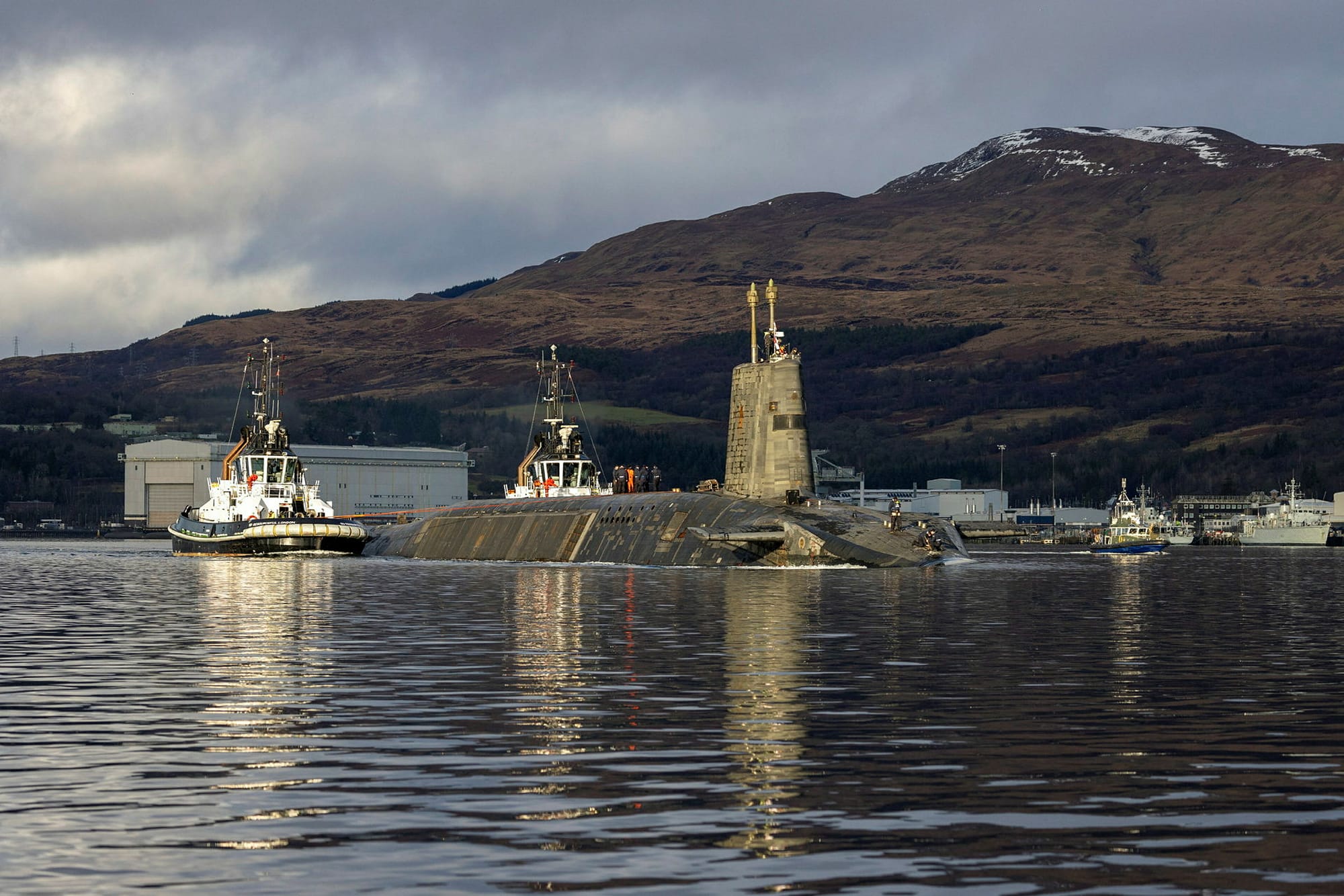
Peter Burt from Nukewatch UK warned that putting three nuclear-armed submarines to sea was irresponsible. "No doubt the UK thinks that it is sending out signals of strength and resolve over its nuclear posture, but these signals may be interpreted in a totally different way by the Russian government,” he said.
“They may conclude that they need to raise their own nuclear forces to a higher state of alert, particularly at a time when other Nato states are conducting nuclear exercises.”
Burt accused the UK government of “following Putin’s lead and acting provocatively”. The consequences of a misunderstanding “could be grave”, he argued. “The UK government should be working to improve the international situation, and not stoking up a crisis.”
Hans Kristensen, a nuclear weapons analyst from the Federation of American Scientists in Washington DC, thought that Nukewatch’s explanations were plausible. The US shared nuclear targeting information with the UK, so it was “potentially possible” that a Vanguard submarine was taking part in the Global Thunder exercise, he said.
Dave Cullen, a UK nuclear weapons expert from the Basic nuclear think tank in London, questioned why the MoD hadn’t taken advantage of having three seaworthy Vanguard submarines to reduce the length of patrols. “Why has the MoD decided to prioritise some other activity instead?”, he asked.
The Scottish Campaign for Nuclear Disarmament pointed out that three nuclear-armed submarines could “wreak global catastrophe almost beyond comprehension”. Any “nuclear posturing” threatened humanity, said the campaign’s Samuel Rafanell-Williams.
“Even if these boats are merely participating in exercises, there is always the risk that an abnormal deployment could send the wrong signal to other countries, prompting an escalation in nuclear tensions.”
The MoD has a long standing policy not to comment on submarine operations to protect national security. “Our nuclear deterrent is the cornerstone of our national security, protecting the UK and our Nato allies every moment of every day,” said a spokesperson.
“We remain the only European ally to commit its nuclear deterrent to the defence of Nato. This means that all Nato allies already benefit from the protection of our nuclear deterrent.”
The MoD, the US military and Nato all stressed that nuclear exercises were annual events. They were “not in response to actions by any nation, other actors or current world events,” they said.
Our reporting makes a difference
Good journalism should reveal something new, stand up to scrutiny, and leave the public better informed. That takes time – and your support.

As staff at Scotland’s largest university continue strikes over sweeping cuts, their boss still won’t say what his second job pays on top of his £425,000 salary.

Scientists argue that research using animals is vital for the treatment and cure of human diseases like cancers. But experimenting on dogs and monkeys is controversial and critics say alternative methods should be used.

The Scottish Government is selling surveillance planes to save money and says drones are used to prevent illegal fishing. But critics argue that losing experienced pilots could mean criminality goes unchecked.


Ithaca Energy announced a major dividend on the eve of UK sanctions against companies operating in illegal Israeli settlements. A few weeks later it paid out £100m to a shareholder the UN says has ‘direct links’ to the occupied territories.
