

Claim 'abortion to birth' is now legal in the UK is Mostly False
Changes to abortion law in England and Wales have been misrepresented on social media.
Changes to abortion law in England and Wales have been misrepresented on social media.
Climate change is causing rising sea levels and coastal erosion and 109 Scottish golf courses are at risk. We examined the issue as part of Green drive: Golf and the environmental crisis – a special Ferret series on golf and the environment.
The Ferret exposed the extreme views of Reform UK’s Scotland’s candidates before Nigel Farage promised to improve his party’s “poor” vetting processes, but many of them have been re-selected to fight the Holyrood election.
Hundreds of protected areas are under pressure from Scotland’s massive deer herd. Most agree deer numbers must be controlled to protect the environment, but are split on what should be done.

Nearly 300 protected areas are being damaged or put at risk by Scotland’s rampant deer population, including breeding grounds for capercaillie – a bird facing extinction, The Ferret can reveal.
The iconic but vastly overpopulated animals are harming famous locations, including Ben Nevis, Glen Coe, the Cairngorms and Loch Lomond and the Trossachs national parks, and the critically rare Caledonian forest.
Some breeding grounds for capercaillies, golden eagles, golden plovers, greenshanks and red-throated divers have been put under pressure by deer.
In excessive numbers, deer degrade land by trampling over and eating too much vegetation, and stripping bark with their antlers, which can kill trees.
Rampant deer also harm the plants and animals that rely on these habitats, and allow plants they do not eat to dominate, according to the John Muir Trust.
 Richard Baynes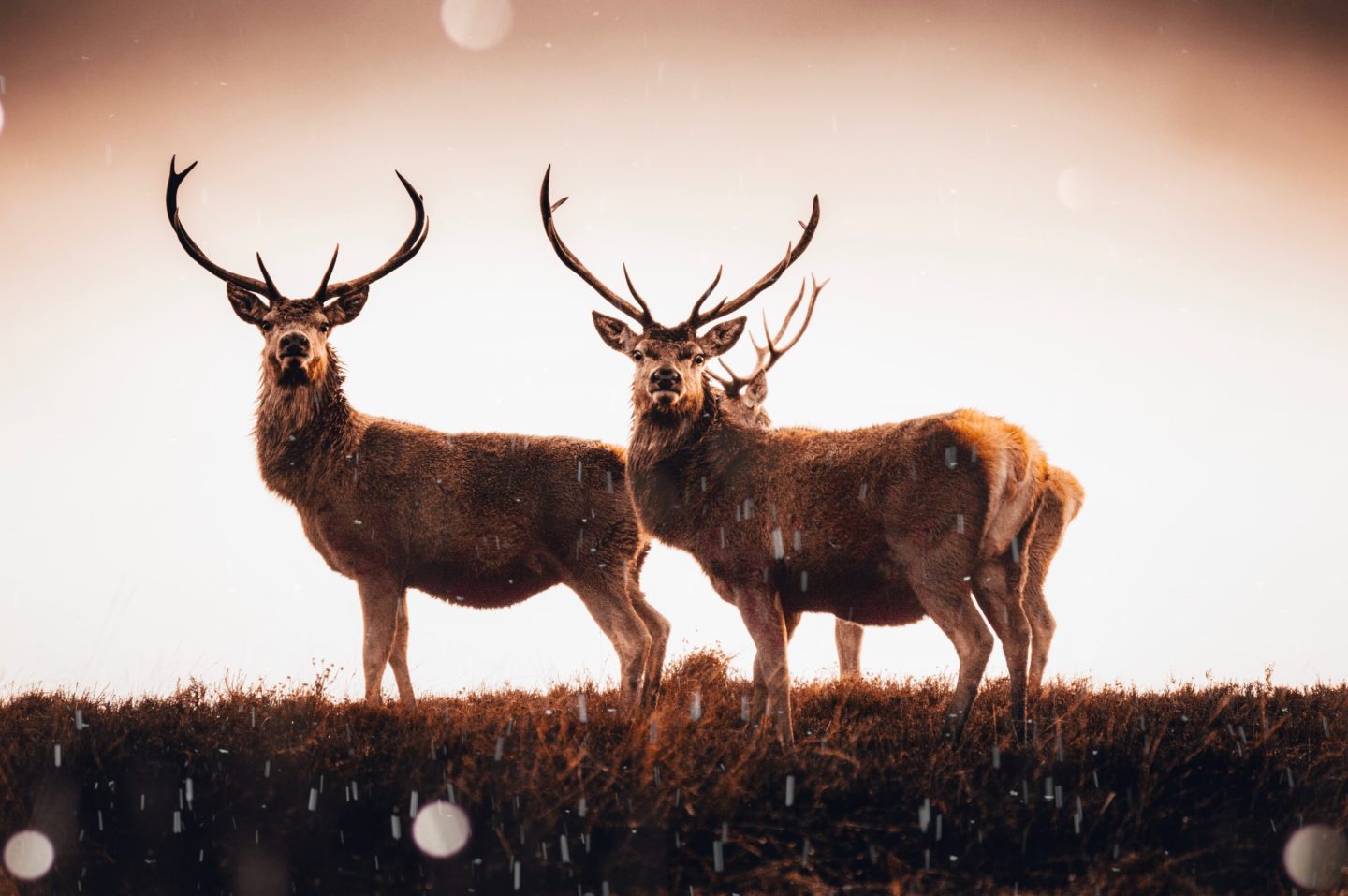
There are thought to be close to a million deer in Scotland, with at least 100,000 culled annually.
Deer pressure on nationally and globally important protected areas is revealed in data we obtained via freedom of information from NatureScot, the Scottish Government’s wildlife agency.
It considers some of the sites affected to be the best remaining representations of Scotland’s “natural heritage”.
They include the Loch Lomond site used for breeding by capercaillie – a species on the verge of extinction in Scotland. Their breeding grounds were found to be in an “unfavourable” and “declining” condition by NatureScot.
The wildlife agency said deer can damage the nests of ground nesting birds by walking over them, but stressed that deer were unlikely to have been solely responsible for a breeding site to be in poor condition.
Five Caledonian forest sites were under pressure from deer, with all found to be in an "unfavourable" state. They include woodland at Ben Nevis, the Ardgour peninsula, Ballochbuie near Braemar, and Amat Wood – the largest native pinewood in Sutherland.
These five clusters are among the 84 remaining fragments of Caledonian pinewoods, which are at risk of vanishing altogether, according to the Trees for Life charity.
NatureScot’s data shows that deer were pressuring 230 of Scotland’s 1,422 sites of special scientific interest (SSSIs), 52 of the 243 special areas of conservation, five of the 162 special protection areas, and two of the 51 “globally-important” Ramsar wetland sites.
SSSIs best represent Scotland’s nature due to their diversity features like plants, animals and habitats, according to NatureScot.
Deer had at least some "negative" effect on all but 11 parts of these 289 protected sites, harming 415 features including woodlands, forests, and grasslands.
Some 309 of these aspects were in an “unfavourable” condition, while 132 were found to be “favourable”. Compared to previous assessments, 144 had deteriorated while the remainder had not changed or were recovering.
NatureScot stressed that features can face other pressures beyond deer that contribute to their overall condition.
Scotland’s deer herds have risen dramatically over the decades. Estimations cited by the Scottish Government found that red deer numbers had doubled from 155,000 to 300,000 between 1959 and 1990.
Today, more than 833,000 – made up of 500,000 red, 300,000 roe, 25,000 sika and at least 8,000 fallow deer – have been recorded according to NatureScot. But the government pointed to 2021 research saying the figure was thought to be “well on its way” to a million.
The John Muir Trust says that, “broadly speaking”, more than five deer per sq km prevent natural woodland regeneration, while exceeding eight per sq km risks damage to peatlands, which store vast amounts of carbon – which causes global warming if released.
The Scottish Government accepted a recommendation from the independent Deer Working Group that there should be no more than 10 red deer per sq km in large open areas in the Highlands. But it added that appropriate densities can vary depending on the area.
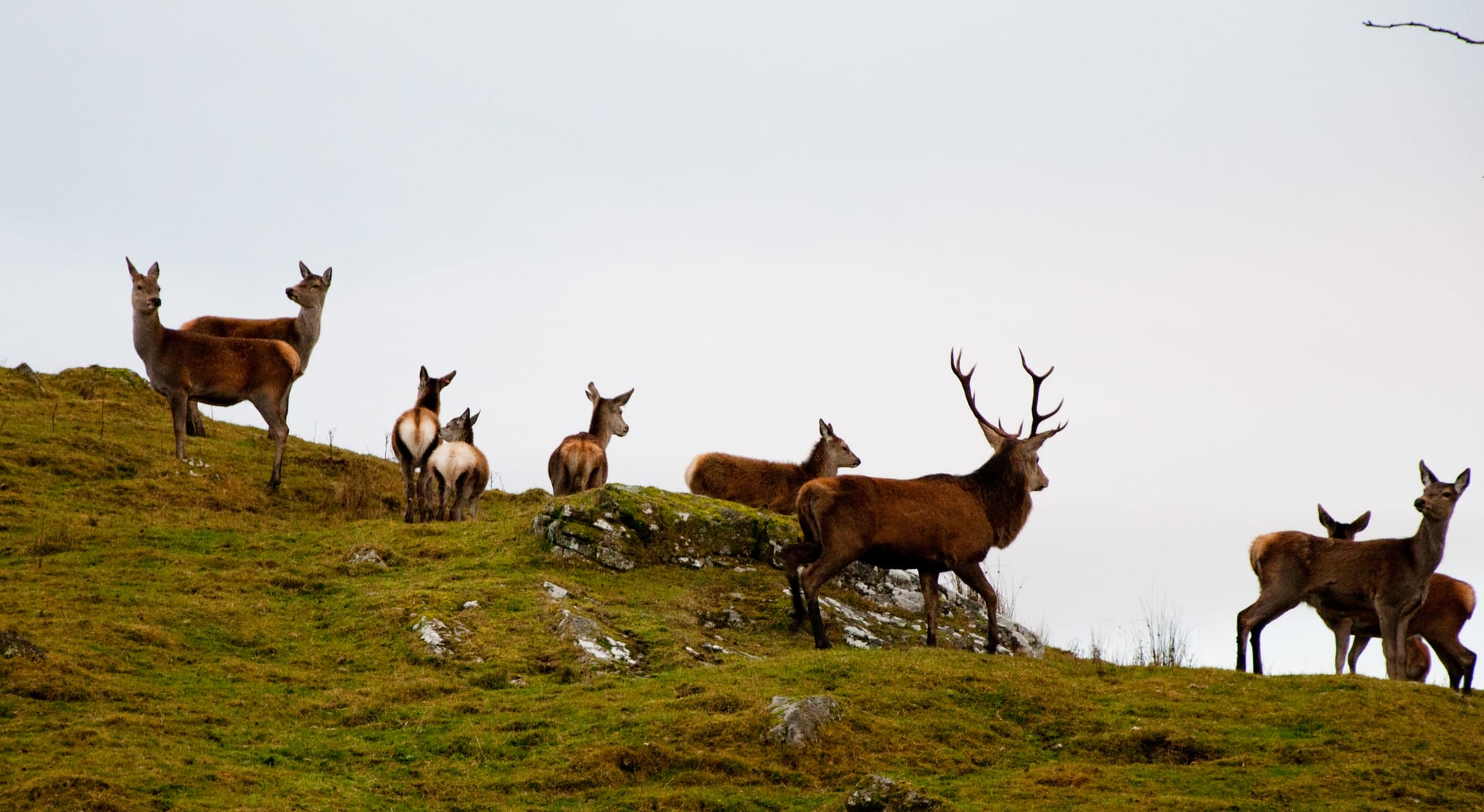
To control the overpopulated animals, which have no surviving natural predators, deer are culled by NatureScot and Forestry and Land Scotland on public land, and land managers and others on private estates. NatureScot says the annual recorded cull is over 100,000, but numbers could be as high as 200,000.
However, it estimates that 50,000 more deer must be killed every year to meet nature and biodiversity targets.
Deer control is voluntary, rather than compulsory, but NatureScot has the power to cull deer on behalf of non-compliant landowners “when necessary to protect our natural heritage”.
It did so in 2023, killing 160 deer at Loch Choire estate in Sutherland. With 13 per sq km, the animals threatened four designated peatland SSSIs. This cost taxpayer-funded NatureScot £25,000, minus £8,000 it recouped in venison sales.
In April, the government approved a compulsory deer control scheme at the estate – the first time one has ever been used – in order to protect the SSSIs.
Conservative MSP Edward Mountain said the decline of capercaillie at Loch Lomond “cannot be pinned on the door of deer”.
“Ineffective predator control of foxes, pine martens and badgers will cause more damage than deer’s hooves and this is clearly evidenced at Abernethy which is run by RSPB and which has the fastest declining population of capercaillie in Scotland,” he said.
RSPB, however, claimed the Abernethy capercaillie population was increasing, albeit “slowly in contrast to most other places in its remaining range”.
“We’ve focussed on habitat improvements including reducing deer numbers, grazing with cattle, and vegetation cutting rather than predator control and this approach seems to be working for us,” said Duncan Orr-Ewing, RSPB’s head of species and land management.
Politicians, academics and conservationists agree that Scotland’s deer herd must be managed, but there are splits on what the process should look like.
The Scottish Wildlife Trust branded overgrazing by deer “a key blocker in efforts to tackle climate change and reversing nature loss by 2045 – commitments to which the Scottish Government itself has pledged”.
Unless numbers are cut, “we risk our most special places for wildlife suffering further damage”, said Bruce Wilson, the charity’s head of policy.
“Funded training and support must also be made available to rural communities”, he added.
Green MSP Ariane Burgess said that if Scotland is “serious about reversing nature loss and tackling the climate emergency, we have to get deer densities down to levels that allow woodlands and peatlands to recover”.
Some estates had allowed deer numbers to balloon “just to guarantee paying clients animals to shoot”, while stalkers who “understand the scale of the problem” are “constrained by the priorities of the landowners and land managers who call the shots,” she alleged.
Scottish Land and Estates (SLE) claimed 80 per cent of deer management was voluntarily handled by private landowners “often at a net cost”.
“Where deer are causing damage, NatureScot have powers to intervene... and SLE supports the principle of having a regulatory backstop”, said Ross Ewing, director of moorland and special projects. “However, an approach predicated on incentives is more likely to enable more effective deer management to take place.”
 Richard Cross
The Association of Deer Management Groups said that while it was working with NatureScot to count, manage and assess the impacts of deer, “the solution isn’t simple”.
Its chair, Tom Turnbull, said herd numbers may be growing outwith the Highlands “where divergent land management objectives, more fragmented ownership and increased forestry and woodland cover means deer management presents even greater challenges.”
Davy McCracken, head of SRUC’s hill and mountain research said the issue is not “as straightforward as simply reducing deer numbers” and “requires a coordinated approach to build local partnerships and base management decisions on solid ecological evidence”.
Scottish environmental policy has been “encouraging a greater focus on sustainable deer management in recent years” and would be buoyed by legally binding biodiversity targets set out in the Natural Environment Bill going through parliament, he added.
NatureScot agreed the bill would “further modernise, clarify and streamline deer management legislation in Scotland, fulfilling many of the recommendations of the independent Deer Working Group”.
“These changes will better support efforts to restore priority areas such as native woodlands and peatlands by reducing the impacts of deer grazing and trampling,” said a spokesperson. They emphasised that NatureScot puts a “strong focus” on reducing deer impacts in “priority areas”, including protected ones.
The spokesperson added: ”Sustainable deer management is vital if we are to bring populations in balance with the rest of nature and effectively tackle the twin crises of biodiversity loss and climate change.”
Header image credit: David O'Brien
We updated this article at 11:00 on 2/12/2025 to correct a line which claimed that NatureScot was aware of deer eating the nests of ground nesting birds. NatureScot confirmed that while it is aware of instances of sheep and cattle eating the nests of ground nesting birds, it was not aware of the same activity from deer.


Climate change is causing rising sea levels and coastal erosion and 109 Scottish golf courses are at risk. We examined the issue as part of Green drive: Golf and the environmental crisis – a special Ferret series on golf and the environment.

Anas Sarwar's party accepted over £7,000 from Stonehaven, a lobbying firm which represents the owner of Scotland's last nuclear power station. Scottish Labour has sought to make nuclear power a battleground in the May election.

Britain Remade has appointed two directors from a lobbying firm which represents EDF, the owner of Scotland’s last nuclear power station.

A Ferret investigation has found there was no registration to sell vapes at the Union Street premises in Glasgow where a major fire started - and we can reveal the name of the company behind the shop.


